
Spend enough time photographing bears in Alaska and eventually you will have an encounter that looks almost unbelievable from the outside.
A bear walks toward you.
You stay where you are.
It keeps coming.
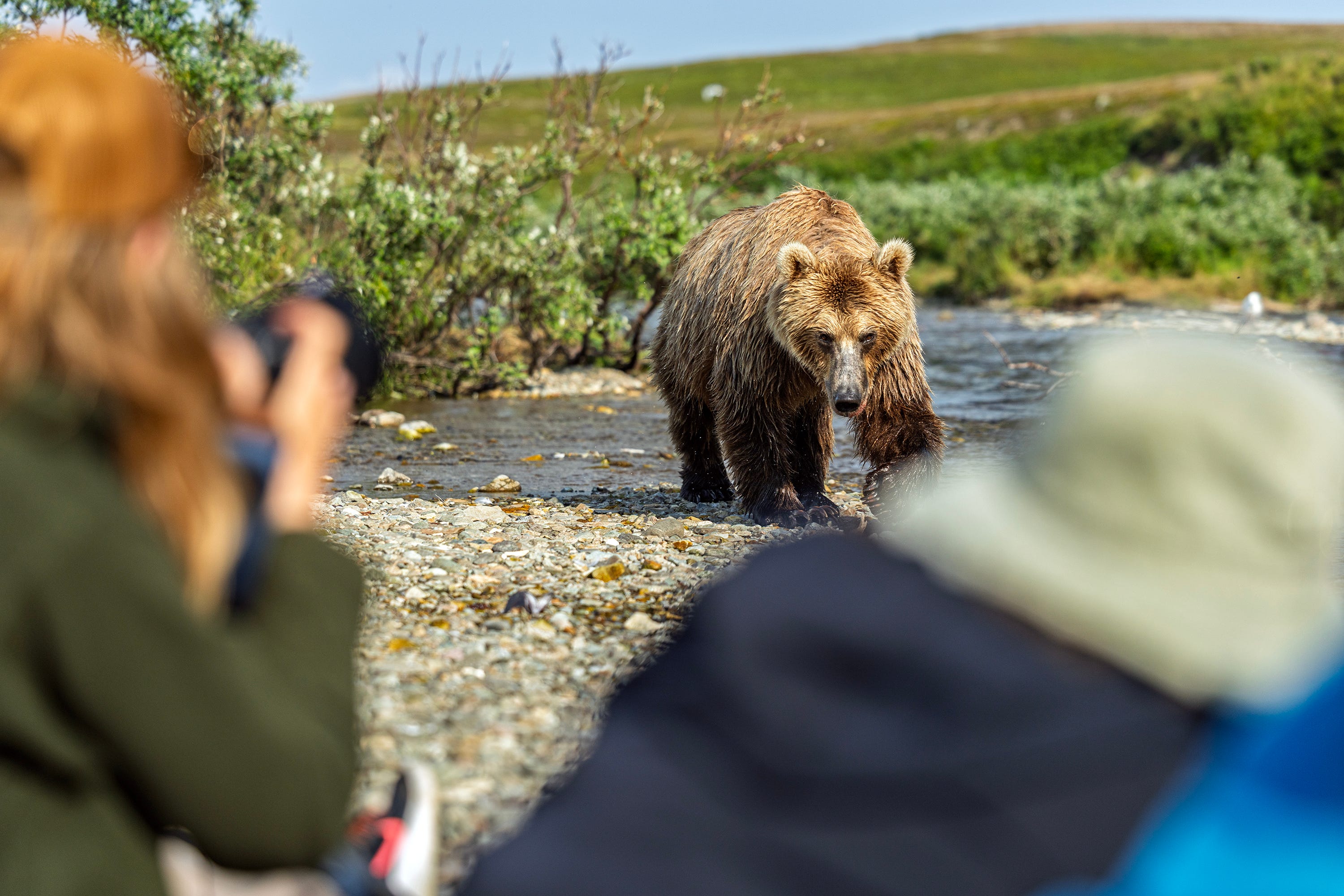
Sometimes it passes surprisingly close before continuing on its way, seemingly unconcerned by your presence.
Share a photograph or video of an encounter like this online and inevitably someone will ask the question: Why are you so close to the bear?
It is a fair question. And the answer is more complicated than you would expect.
After thousands of encounters with bears, I have learned that distance is only one part of understanding whether an encounter is safe, responsible and ethical.
Context matters.
Approaching a bear is very different from a bear approaching you
This is probably the most important distinction to understand.
When we photograph brown bears in Alaska, our goal is not to see how close we can get. Quite the opposite.
In many of the places where I guide, we find a location, keep our group together and let the bears dictate what happens next.
We don’t chase them down the riverbank. We don’t surround them. We don’t continually move closer because someone wants a better photograph.
We watch.
A bear might remain hundreds of yards away. It might change direction and disappear. Or it might continue feeding and gradually work its way toward us.
When that happens, our responsibility is to remain predictable and pay extremely close attention to what the bear is telling us.
There is an enormous difference between walking up to a bear and sitting quietly while a bear chooses to walk toward you.
The photograph at the end might look similar.
The encounter is not.
Alaska can be different
This is also why I would never tell someone that because an encounter was appropriate in one part of Alaska, the same thing would be appropriate somewhere else.
Bear behaviour exists within a context.
Some of the places where we photograph bears in Alaska contain extraordinary concentrations of natural food. During the salmon run, bears can have access to an abundance of calories and may spend much of their day focused on fishing and feeding.
The terrain can also be very open. We can see the bears. The bears can see us. There are fewer surprises.
Perhaps most importantly, bears in some of these areas have had generations of largely neutral experiences with people. They have learned that a group of humans sitting quietly along a river is neither food nor a threat.
This is known as habituation.
And habituation is frequently misunderstood.
A habituated bear is still a wild bear
Habituation does not mean a bear is tame.
It does not mean the bear has been trained.
And it certainly does not mean the bear should be fed.
Habituation simply means an animal has become accustomed to a repeated stimulus that has neither positive nor negative consequences.
In this case: us.
A bear may encounter people repeatedly and learn that those people can simply be ignored.
That is very different from food conditioning, where a bear begins associating humans with food.
Food conditioning can be incredibly dangerous. Once a bear learns that people, camps, vehicles or buildings represent an opportunity for food, its behaviour can change dramatically. And far too often, the bear ultimately pays the price.
The bears we photograph are there for natural food. They are fishing for wild salmon, digging for clams, eating vegetation, raising cubs, resting and interacting with other bears.
We are observers in their world.
What I am watching when a bear gets close
People sometimes assume that experienced bear guides simply become comfortable with bears.
I don’t think that’s the right way of looking at it.
Experience should make you more attentive, not less.
When I am around bears, I am constantly watching them.
Where is the bear going?
What is it doing?
Is it feeding normally?
Has its behaviour changed since it noticed us?
Is it repeatedly looking toward us?
Has it altered its direction of travel?
What are its ears doing?
What is its posture telling me?
Are there other bears nearby?
Are cubs involved?
What escape routes are available to the bear?
What is happening in the surrounding environment?
There is no single behaviour that tells you everything. You are constantly trying to understand the complete picture.
And bears communicate far more than most people realize.
The more time you spend with them, the more you begin to recognize how much information they are constantly giving you.
Our responsibility is to listen.
The goal is never to get close
This is something I think is particularly important in wildlife photography.
Proximity should never be the objective.
Some of the most extraordinary encounters of my life have involved bears coming extremely close. But the distance itself isn’t what made those encounters special. It was knowing that the bear had the freedom to make its own decisions.
Sometimes a bear chooses to come close. Sometimes its behaviour tells us that the right thing to do is create more space. And sometimes a bear remains hundreds of yards away for the entire encounter.
All of those are equally valid wildlife experiences.
The point is that we don’t begin an encounter with a desired distance in mind. We respond to the individual bear, the environment and the circumstances in front of us. If the bear is relaxed and chooses to approach, we may stay where we are. If its behaviour changes or it shows any sign that our presence is affecting what it wants to do, we create space.
The photograph we come home with is always secondary to allowing the bear to make its own choices.
That’s wildlife.
I don’t believe the ethical question should simply be:
“How close did you get?”
A much better question is:
“How did your presence affect the animal?”
Did the bear stop feeding because of you?
Did it repeatedly look toward you?
Did it change direction or abandon where it wanted to go?
Did you block its path?
Did you continue pushing closer after it showed discomfort?
Did getting the photograph become more important than the animal’s behaviour?
Those questions tell us far more about an encounter than distance alone.
Context cannot be copied
None of this is an invitation to approach bears.
A brown bear fishing for salmon in an open Alaskan river, a grizzly unexpectedly encountered on a wooded trail in Montana, a food-conditioned bear wandering through a campground and a polar bear approaching across the tundra are completely different situations.
Different species, populations, habitats and individual animals can require very different responses.
Local regulations matter.
Local knowledge matters.
The environment matters.
The individual bear matters.
And if you don’t have extensive experience interpreting bear behaviour, giving a bear more space is almost always the better decision.
What is appropriate with one bear, in one place, under one set of circumstances should never be assumed to be appropriate somewhere else.
Social media removes the context
This is one of the difficult things about sharing wildlife encounters online.
A photograph captures a fraction of a second.
A video might show ten seconds.
Neither necessarily tells you what happened during the previous hour.
You don’t know whether the photographer approached the animal or the animal approached the photographer. You don’t know how long everyone had been sitting there. You don’t know what the bear was doing beforehand. You don’t know the local regulations, the landscape or the history of that bear population with people.
This cuts both ways.
Irresponsible wildlife encounters can look completely harmless online.
And responsible encounters can sometimes look irresponsible.
That is why I think we need to have more nuanced conversations about wildlife photography rather than judging every encounter by how many feet appear to separate an animal from a person.
Bears are not the animals we have been taught to fear
I have spent a significant part of my life around bears.
The more time I spend with them, the more convinced I become that they are among the most misunderstood animals on Earth.
That doesn’t mean they aren’t powerful.
They are.
It doesn’t mean there is no risk involved in being around them.
There is.
Respecting bears means acknowledging both of those realities without turning them into monsters.
Bears are intelligent, complex and remarkably communicative animals. Most of the time, they want exactly what we want: enough space to go about their lives without conflict.
After thousands of encounters, being around bears has not taught me to fear them less because I think they are harmless.
It has taught me to understand them better.
And there is an important difference.
Being a good bear guide isn’t about being fearless around bears. It is about respecting them enough to recognize that every encounter is different.
Sometimes that means creating considerable distance.
Sometimes it means leaving an area altogether.
And sometimes it means sitting quietly while a wild bear chooses to walk surprisingly close.
We don’t get to decide what the bear should be comfortable with.
The bear should always have the final say.
Quote of the Day
The greatest enemy of knowledge is not ignorance, it is the illusion of knowledge.
— Stephen Hawking
On the road again…
After a short stint at home, I’m traveling again to my second home in the Masai Mara, Kenya. I already miss the family, especially after being away so much this year. It’s one of the harder parts of this life. I feel incredibly lucky to spend so much of my time in wild places, doing work that I love and that means a lot to me, but there is also a lot that happens behind the scenes to keep this life going. The travel itself is only a small part of it. There are always emails to answer, trips to plan, permits and logistics to sort out, photos and stories to work on, conservation projects moving forward, and a seemingly endless list of things that pile up whenever I disappear into the field. I’m still behind on many things and slowly catching up, so thank you to everyone who has been patient with me. It’s a constant balancing act between family, travel, the work, and actually being present in these places when I’m lucky enough to be here. I definitely don’t always get that balance right, but I’m working on it. More soon…
Thank you for being part of The Wildlife Collective. Together, we are helping build a deeper connection between people and the natural world while supporting the conservation of wildlife and wild places. Stay tuned for more stories from the field, conservation news, photography tips, and unforgettable wildlife encounters from around the globe.
Until next time, keep exploring, keep learning, and keep falling in love with the wild.
Zac Mills
The Wildlife Collective