
I have been thinking about this lately.
Wildlife photography and landscape photography both sit under the broad umbrella of nature photography. Both get us outside. Both can take us to extraordinary places. Both require patience, an understanding of light, and a willingness to get up at ridiculous hours.
But they feel very different.
And I wonder if that difference helps explain why wildlife photography seems to be becoming more and more popular.
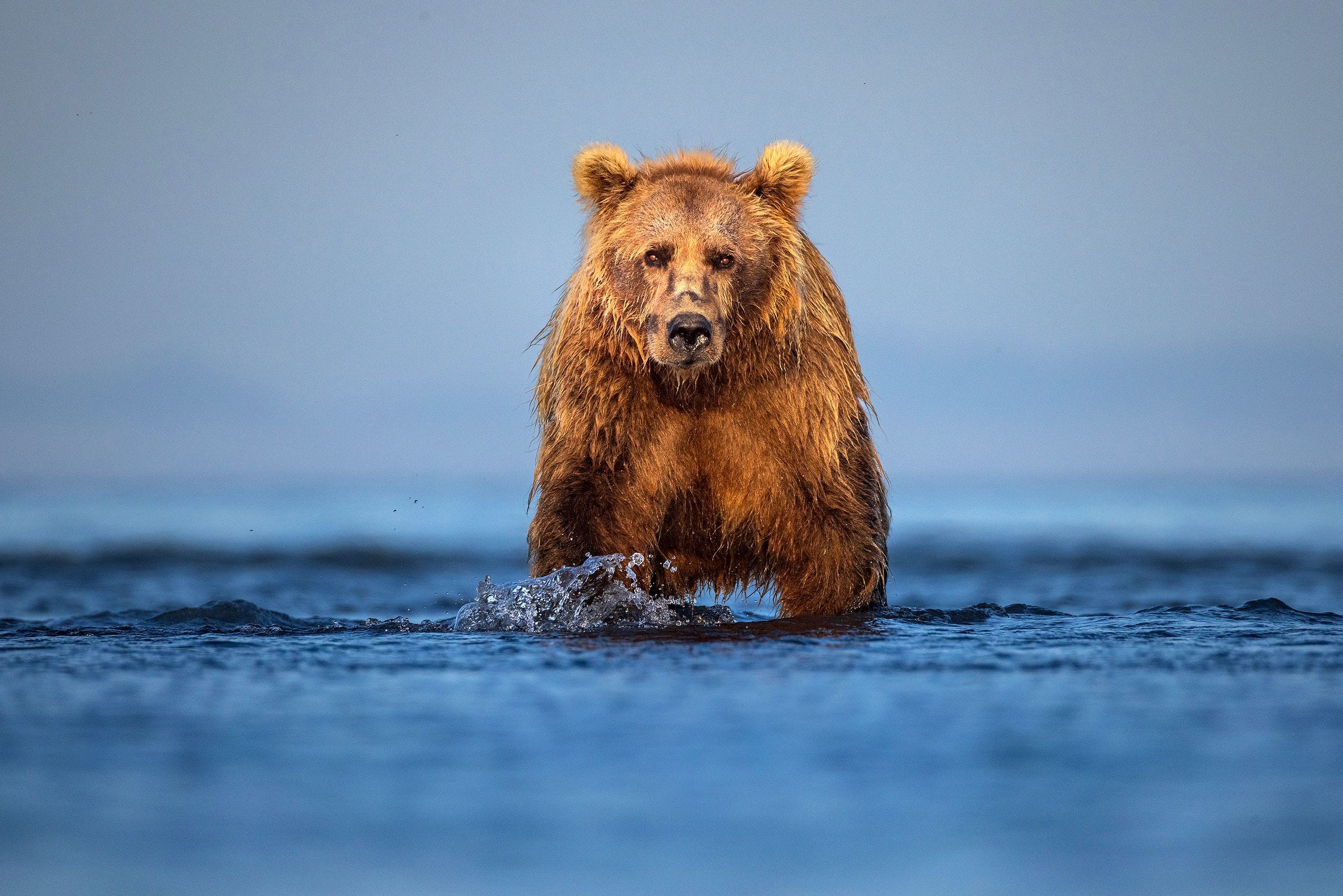
Is wildlife photography simply more exciting?
I should probably acknowledge my bias immediately. I am a wildlife photographer. I have spent an unreasonable amount of my life looking for bears, big cats, great apes and other animals. I will happily sit beside a river for hours waiting for a bear to appear.
But I also love landscapes.
There is something incredibly satisfying about standing in front of a beautiful scene as the light begins to change. Watching the first light hit a mountain. Waiting for fog to lift from a valley. Seeing a storm build over a landscape and realizing that, for a few minutes, everything might come together.
Landscape photography can be spectacular.
But wildlife adds something else.
Unpredictability.
You can research an animal. You can understand its habitat. You can learn its behavior. You can put yourself in the best possible position.
And then absolutely nothing happens.
Or everything happens.
A bear suddenly appears from the grass.
A leopard steps out of the darkness.
A wolf begins running toward the river.
An orangutan swings into an opening in the canopy.
A mother walks into view with cubs you didn’t even know existed.
Suddenly your heart rate changes. You’re trying to watch what is happening while simultaneously thinking about shutter speed, exposure, composition, background and where the animal might move next.
And there is no asking it to do it again.
That, for me, is the magic of wildlife photography.
You Never Really Know What Is Going to Happen
Landscape photography certainly has unpredictability. Anyone who has waited for a sunrise that never appeared knows that.
Weather changes. Clouds disappear. Fog rolls in. Light does things you never expected.
But the mountain usually stays where you left it.
Wildlife has its own agenda.
You can spend days looking for an animal and see nothing. Then, when you have almost given up, you can have an encounter that lasts thirty seconds and makes the entire trip worthwhile.
Some of my favorite wildlife experiences have happened when almost nothing was going according to plan.
That uncertainty becomes addictive.
Every bend in the river might reveal something.
Every movement in the grass catches your attention.
Every alarm call means something.
Every set of tracks makes you wonder how recently the animal passed through.
You aren’t just photographing.
You’re searching.
You’re watching.
You’re listening.
You’re anticipating.
And then, occasionally, you find yourself in exactly the right place at exactly the right moment.
There Is Something About Another Living Being
I think there is another reason wildlife photography feels different.
There is someone on the other side of the photograph.
Not someone in the human sense, obviously. But another living creature making decisions independently of you.
A bear chooses where it wants to walk.
A puma decides whether to hunt.
An elephant reacts to another elephant.
A mother protects her young.
A young animal explores a world it is still trying to understand.
The photographer has almost no control over any of it.
Our job is simply to observe.
And when you spend enough time with wildlife, photography can become secondary to what you are watching.
You begin noticing personalities.
Relationships.
Curiosity.
Fear.
Confidence.
Playfulness.
Tolerance.
Sometimes you lower the camera because whatever is happening in front of you is more important than making another photograph.
Those are often the moments I remember most.
Maybe That Is Why Wildlife Photography Is Growing
It certainly feels as though wildlife photography has exploded in popularity.
Social media is filled with wildlife images and videos. More photographers seem to be traveling specifically to photograph animals. Wildlife photography trips that once felt fairly niche can now sell out far in advance.
Maybe part of that is simply the world we live in.
Wildlife is incredibly compelling on a screen. A bear looking directly toward the camera creates an immediate connection in a way that even a spectacular mountain sometimes struggles to do.
But I think there is something deeper happening too.
People want experiences.
And wildlife photography is as much about the experience as the photograph.
The image becomes the souvenir of a much bigger story.
You remember waking before sunrise.
The cold.
The waiting.
The searching.
The moment someone whispered, “There.”
The first glimpse.
The adrenaline.
The animal disappearing again.
Sometimes you travel halfway around the world and come home with thousands of photographs.
Sometimes you come home with one.
Sometimes none.
And somehow you still want to go back.
But Excitement Isn’t Everything
This is where I think the comparison becomes interesting.
Maybe landscape photography isn’t trying to provide the same thing.
Wildlife photography often makes me feel alert.
Landscape photography often makes me feel still.
One is about reacting to something happening in front of you.
The other can be about slowing down enough to notice what has been there all along.
And perhaps we need both.
I have stood in front of landscapes that have affected me as deeply as any wildlife encounter. Places so vast and beautiful that taking a photograph almost feels beside the point.
There is a different kind of patience involved.
You aren’t waiting for an animal to do something.
You’re waiting for light.
For weather.
For atmosphere.
Sometimes you’re simply waiting for yourself to stop rushing.
There is something wonderful about that too.
Wildlife Has One Unfair Advantage
There is one thing landscapes cannot do.
They cannot look back at you.
Anyone who has spent time around a wild animal knows the feeling.
For a moment, an animal becomes aware of you.
A bear lifts its head.
A gorilla looks across the forest.
A tiger stops and watches.
You look at it.
It looks at you.
And for a few seconds there is this strange acknowledgement between two completely different lives.
Then the animal turns away and continues with its day.
Those moments stay with you.
Photography gives us a reason to seek them out, but I increasingly think the photograph is only part of why we do this.
We go because we want to feel something.
Wonder.
Curiosity.
Anticipation.
Connection.
And yes, excitement.
Maybe that is why wildlife photography continues to draw so many people in.
Not because it is better than landscape photography.
But because you never quite know what is waiting around the next corner.
And once you have experienced that feeling, it is very difficult not to go looking for it again.
So, is wildlife photography more exciting than landscape photography?
For me, yes.
But perhaps the more interesting question is this:
Which one makes you feel more alive?
Quote of the Day
Life is like a box of chocolates. You never know what you’re gonna get.
— Forrest Gump
Hello from Nairobi
I made it to Nairobi, although not without a little drama. With the airport strike underway, we ended up circling Nairobi for about 45 minutes before we were finally able to land. The strike was still ongoing yesterday and unfortunately led to the cancellation of my guests’ Air France flight, so it has been a slightly complicated start to the trip. But I’m very happy to be back in Kenya. I’m especially excited to share Kapoto Camp with my guests and spend the coming days together in the beautiful Masai Mara. This place means so much to me, and every time I return I’m reminded just how special it is. I can’t wait to get back out into the Mara and see what the next few days bring…
Thank you for being part of The Wildlife Collective. Together, we are helping build a deeper connection between people and the natural world while supporting the conservation of wildlife and wild places. Stay tuned for more stories from the field, conservation news, photography tips, and unforgettable wildlife encounters from around the globe.
Until next time, keep exploring, keep learning, and keep falling in love with the wild.
Zac Mills
The Wildlife Collective