
There are some wildlife moments that stop you in your tracks, and this trip to Borneo gave me one I will never forget.
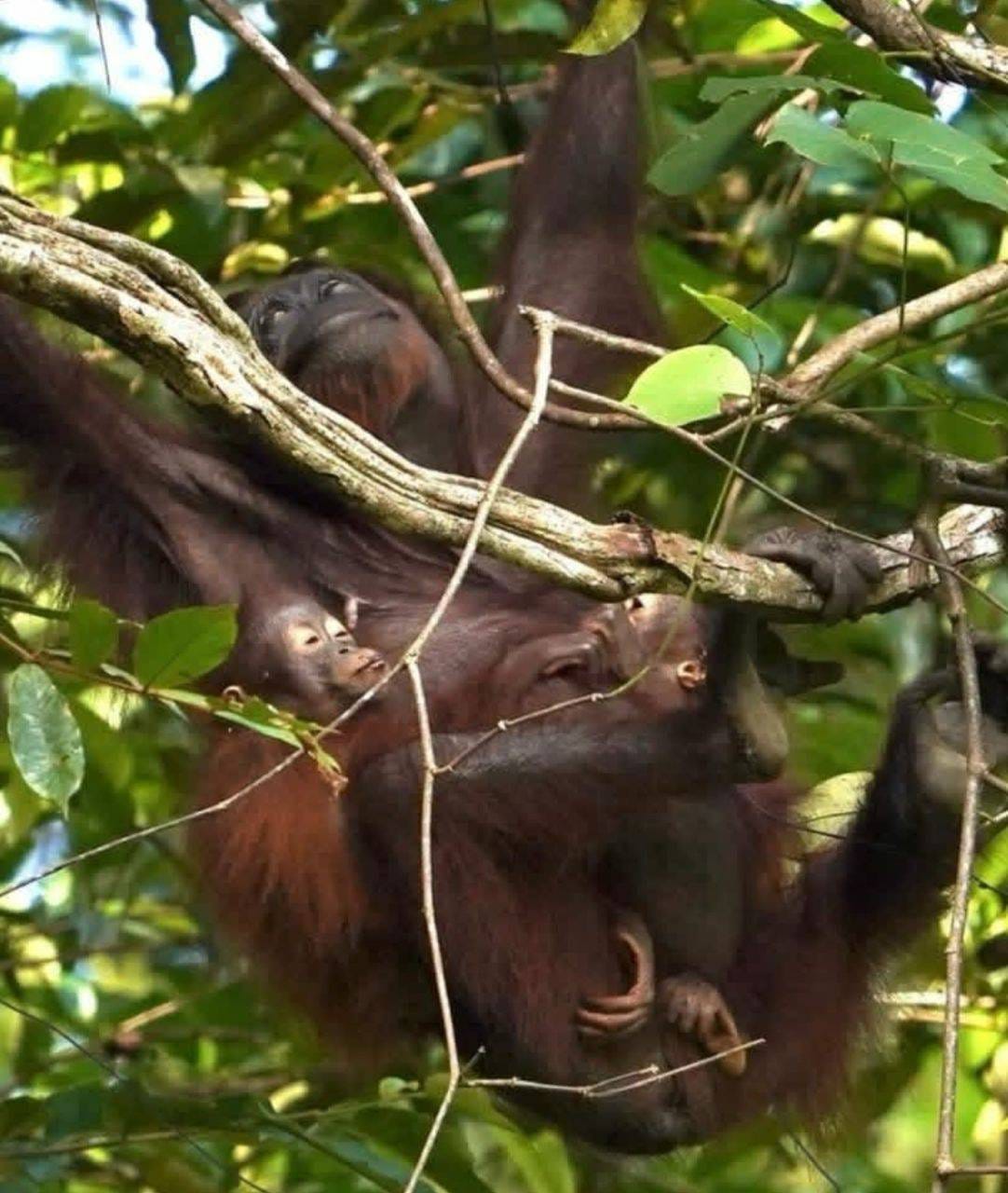
I saw something incredibly rare. An orangutan mother with two babies.
This behavior is known as infant stacking, and it is not something you get to witness often. She was last seen two years ago when the babies were much younger, which makes seeing her again now feel even more special. It is one of those reminders that marvels of nature still exist, even in a world that can sometimes feel like it is losing its wildness.
In just 48 hours in the forest, I saw eight different orangutans, along with gibbons, hornbills, long-tailed and pig-tailed macaques, a leopard cat, civet cat, flying squirrel, flying lemur, and so much more. We heard elephants twice, but I never did get a look at them. That is the magic of a place like Borneo. Every day feels full of possibility, and every drive you take feels like something incredible could happen at any moment.
One animal I really hoped to see on this trip was a wild sun bear. The crazy thing is that the week before I arrived they had what guides here said was the best sighting they have ever had. That is wildlife travel. Sometimes the timing lines up perfectly, and sometimes it does not. I did not see one this time, but that just means I have a good reason to come back, and I definitely will.
While I did not see a wild sun bear, I did have the chance to visit the Borneo Sun Bear Conservation Centre, which was a highlight in a completely different way. The work they are doing there is incredibly important. Many of the bears at the center were rescued from the illegal pet trade or from being kept in terrible conditions, and the goal is always rehabilitation, education, and protecting the future of the species. Seeing these bears up close and learning more about the challenges they face made me appreciate even more how special it is to have places in Borneo where they still live free in the wild.
One of the things I love most about this part of Borneo is how accessible the wildlife is. You can see wild orangutans, monkeys, hornbills, and so many other species without needing long, difficult hikes. Most of the viewing here is done by vehicle safari, which makes it an amazing option for people who want a true rainforest wildlife experience without having to trek for hours every day.
Right now I am sitting in the Singapore airport, about to begin the long journey home, already replaying the last few days in my head. Trips like this always remind me why I keep traveling to these wild places. Not just to see animals, but to experience the incredible beauty, diversity, and fragility of our planet while it still exists the way it does now.
After this visit, I know Borneo is somewhere I want to bring people in the future. We will be running tours here for wild orangutans and so much other incredible wildlife, and I think it will become one of my favorite destinations to share.
If this sounds like something you would be interested in, let me know. Details coming soon.
Quote of the Week
We still do not know one thousandth of one percent of what nature has revealed to us.
— Albert Einstein
Conservation News
Borneo Is Still Wild… But For How Long?
Borneo is one of the most important rainforest islands left on Earth, but it is also one of the places where forest loss has happened at an incredible pace. In 1973, about 75% of Borneo was still covered in forest. By 2015, that number had dropped to roughly 50%, meaning the island lost around 18–19 million hectares of forest (about the size of Florida) in just four decades.
Most of that loss happened in lowland rainforest, the exact habitat that holds the highest biodiversity and the species people travel across the world to see. These are the forests where orangutans, sun bears, clouded leopards, hornbills, and countless other species depend on large, connected landscapes to survive.
The drivers of this deforestation are well known. Industrial logging began opening the interior in the 1970s and 80s, followed by mining, road building, and large-scale agriculture. Palm oil has been one of the biggest factors. Indonesia and Malaysia together produce about 85% of the world’s palm oil, and huge areas of Borneo have been converted into plantations.
Once roads are cut into the forest, clearing almost always follows. What starts as selective logging often turns into permanent loss, and the forest becomes fragmented into smaller and smaller pieces that wildlife cannot easily move between.
Fires have made the situation even worse, especially in peat forests. These forests sit on deep layers of carbon-rich soil that formed over thousands of years. When they are drained and burned, the emissions are enormous. During major fire years, Indonesia has briefly become one of the largest greenhouse gas emitters in the world, largely because of peatland fires in Borneo and Sumatra.
The effect on wildlife has been severe. Since 1999, Borneo has lost an estimated over 100,000 orangutans, mostly because of habitat loss and fragmentation. Sun bears, pygmy elephants, and clouded leopards all depend on huge areas of intact forest, and when those forests are broken apart, survival becomes much harder even if some habitat remains.
In recent years, another major development has added new pressure. Indonesia is building a new capital city, Nusantara, in East Kalimantan on the island of Borneo. The move is meant to relieve pressure on Jakarta, which is sinking and overcrowded, but the new capital sits in one of the most biologically important regions in Southeast Asia.
The project itself covers tens of thousands of hectares, and conservation groups warn that the bigger impact will come from the roads, infrastructure, and expansion that follow. Once access improves, forests that were once too remote to reach can suddenly become vulnerable to logging, mining, and agriculture.
Traveling in Borneo today, you can still experience forests that feel endless. You can still hear gibbons calling at dawn and watch orangutans moving through the canopy like they always have. But the edges are never far away. Plantations, logging roads, cleared hillsides, smoke in the distance.
The forest is still here, but it is no longer unbroken. And what happens on this island over the next few decades will decide the future for one of the richest ecosystems left on Earth.
More Tours Coming Soon
I’m currently preparing our new exclusive polar bear expedition in Nunavut (Oct 19–26, 2026, details coming soon), while also working on a Borneo orangutan & more tour for 2027. We are finalizing our Andean bear tour in Colombia, and exploring the addition of a Sri Lanka itinerary focused on leopards and sloth bears, along with a potential tigers-on-foot experience in Nepal.
If any of these sound of interest to you, feel free to reach out. There is a lot in the works right now, and the 2027 tour calendar is going to be one of our most exciting yet, with several new destinations still to be announced.
2026 Tours with Availability
June 16-24: Bolivia Jaguars on Foot (4 spots)
Sept 2-9: Kenya Big Cat Safari (2 spots)
Sept 13-21: Brazil Jaguars (4 spots)
*NEW Nov 24-30: Mountain Gorillas (3 spots)
*NEW Nov 30 – Dec 5: Mountain Gorillas (3 spots)
Click to see our fill list of tours
Feel free to reply to this email with any questions, feedback, or just to share your latest wildlife photos. Feel free to share this message with fellow nature lovers, too—let’s grow this community together!
Thank you for being a part of The Wildlife Collective community. Stay tuned for more updates, tips, and incredible wildlife encounters!
Best regards,
Zac Mills
The Wildlife Collective