
At The Wildlife Collective, I’ve been very deliberate about focusing on three groups of animals: bears, big cats and great apes.
That specialization has always been important to me. I don’t want us to be a company that tries to offer everything, everywhere. I want us to be the very best at what we do.
I believe specialization helps us deliver better wildlife experiences in so many ways. By returning to the same animals and landscapes year after year, we develop a deeper understanding of their behaviour, build stronger relationships with local guides and conservation partners, and learn the subtle details that can make the difference between a good wildlife experience and an extraordinary one.
We learn when to go, where to look, when to wait, and perhaps most importantly, when to give an animal space.
It’s this depth of knowledge that I believe allows us to offer something genuinely different.
But lately, I’ve been wondering whether it’s time to make room for a fourth group of animals: wolves.
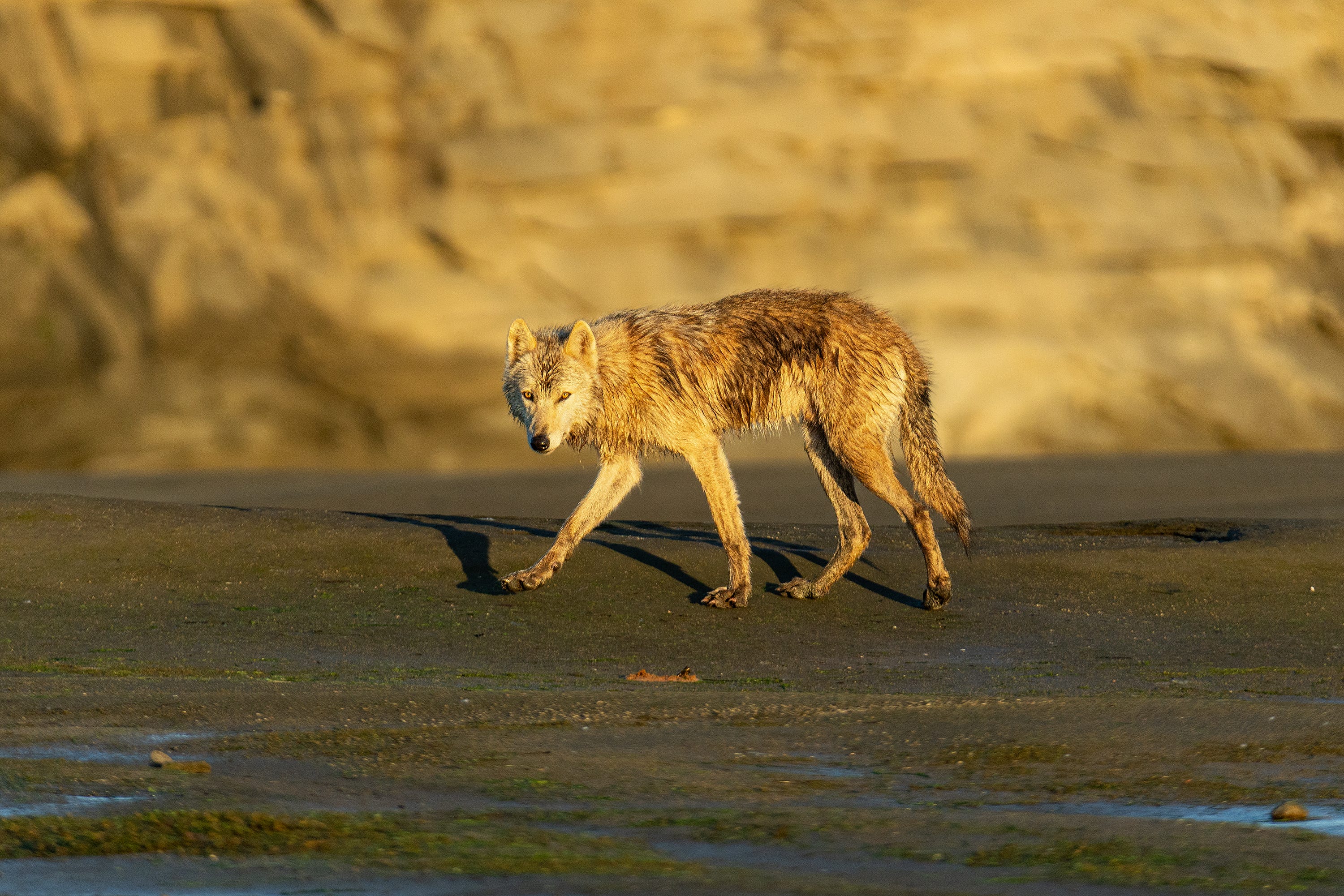
Over the past few years, and particularly after a series of incredible wolf encounters in remote Alaska, I’ve found myself becoming increasingly fascinated by these animals.
Watching wolves in the wild is something special. Their intelligence, their family relationships, the way they communicate and cooperate, and the extraordinary landscapes they inhabit make them endlessly fascinating to observe.
And judging by the feedback from our guests, I’m not alone.
We already offer a Bears & Wolves expedition in one of the most remote parts of Alaska, and elsewhere in Alaska we’ve had some remarkable encounters with wolves living alongside coastal brown bears. Some of those moments have been among the most memorable of our expeditions.
They’ve also made me wonder what we could experience if we dedicated an entire expedition to wolves.
There are some extraordinary possibilities.
Along the wild west coast of British Columbia, coastal wolves inhabit remote islands, temperate rainforests and rugged shorelines. These animals have adapted to a life closely connected to the ocean, making them particularly fascinating to study and photograph.
Farther north, on Ellesmere Island in the Canadian High Arctic, Arctic wolves inhabit one of the most remote and spectacular landscapes on Earth. The opportunity to spend time observing wolves in such an extraordinary environment is something I’ve been thinking about more and more.
Of course, any experience we developed would have to meet the same standards we apply to everything at The Wildlife Collective: small groups, exceptional local knowledge, ethical wildlife viewing, and experiences that put the welfare of the animals first.
I have no interest in expanding simply for the sake of expansion.
But I do believe there’s something compelling about wolves. They’re intelligent, deeply social animals that have been misunderstood and persecuted for generations. And I believe that helping people experience them in the wild, understand their lives and appreciate their importance could be another meaningful way for us to contribute to their conservation.
Perhaps wolves aren’t such a departure from what we’re already doing after all.
They’re another animal whose complexity becomes more apparent the longer you spend with them. Another species whose survival is closely tied to our willingness to coexist with wildlife. And another opportunity to turn extraordinary encounters into a deeper appreciation for the natural world.
So, I’m curious what you think.
Should we expand our focus beyond bears, big cats and great apes to include wolves?
Would you be interested in joining a small-group expedition dedicated to photographing and learning about wild wolves, whether along the remote coast of British Columbia, in the Canadian High Arctic, or somewhere else entirely?
Or do you think we should stick to the three groups of animals we’ve worked so hard to specialize in?
I’d genuinely love to hear your thoughts.
Because while I believe strongly in the value of specialization, I also believe in remaining curious, continuing to learn, and being open to where the wild takes us next.
Quote of the Day
The wolf is neither man’s competitor nor his enemy. He is a fellow creature with whom the earth must be shared.
— L. David Mech
Thank you for being part of The Wildlife Collective. Together, we are helping build a deeper connection between people and the natural world while supporting the conservation of wildlife and wild places. Stay tuned for more stories from the field, conservation news, photography tips, and unforgettable wildlife encounters from around the globe.
Until next time, keep exploring, keep learning, and keep falling in love with the wild.
Zac Mills
The Wildlife Collective