
There are some animals that become part of a place, not just because of how often they’re seen, but because of what they represent. In Banff, that animal is known simply as the Boss. Officially, Bear 122. A massive male grizzly that has come to define the Canadian Rockies.
If you spend enough time in these mountains, you hear about him long before you ever see him. Stories passed between hikers, photographers, wardens, merchandise, sightings along the roadside, tracks bigger than your hand, a presence that shifts the entire landscape. Because when the Boss is around, everything else knows it.
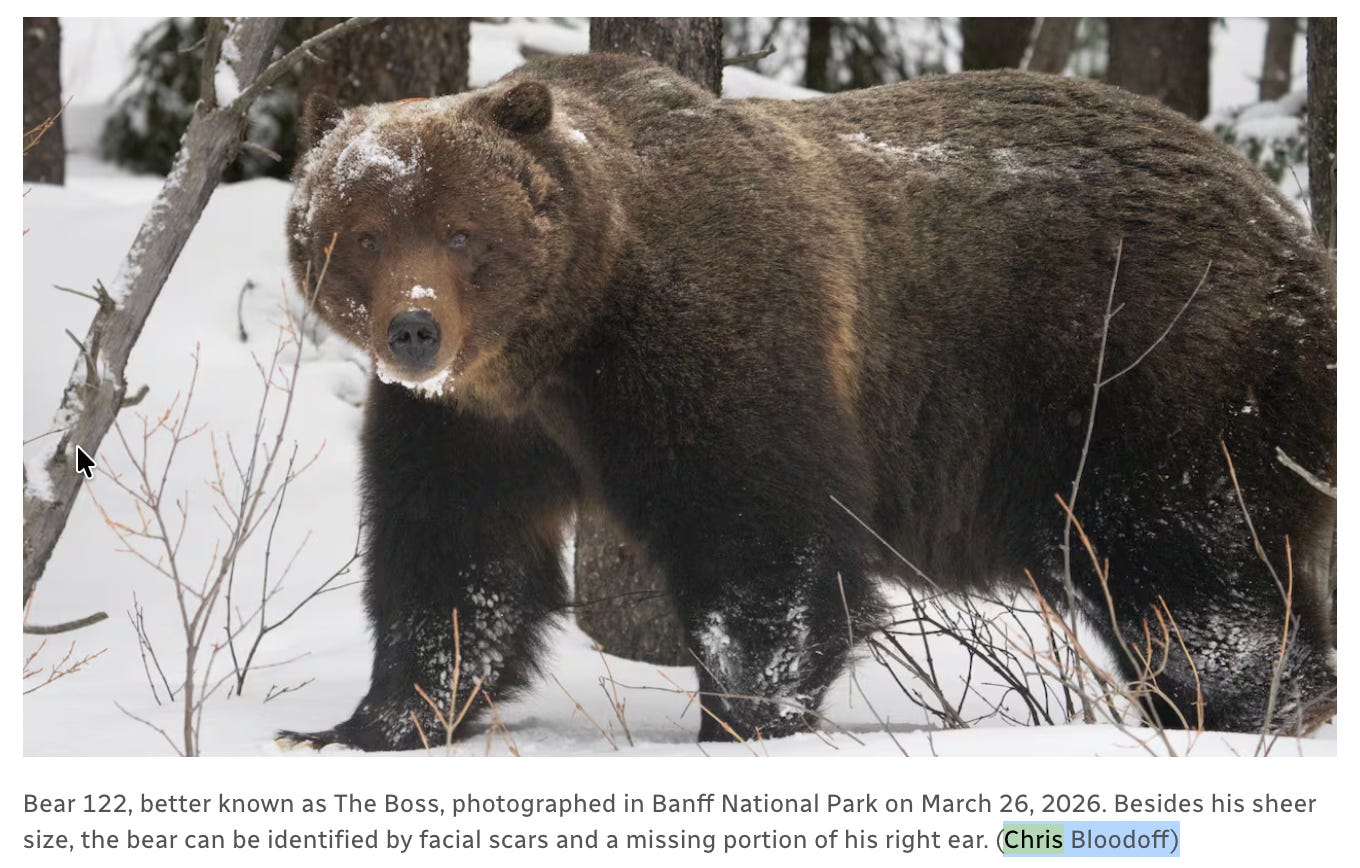
This spring, he’s been seen again, moving through the valley, out of hibernation, back where he belongs. What makes his story even more remarkable is his age. The Boss is estimated to be around 24 to 25 years old, which is incredibly rare for a wild grizzly, especially a dominant male living in a landscape like this. Most don’t make it anywhere near that long. We’ve lost bears here before, and the Boss has come closer than most, having been hit by trains twice and somehow walked away.
And yet, despite all of that, he’s still here, moving through one of the busiest national parks in the world, navigating roads, trains, and people, finding a way.
I’ve only seen him once, and even then just briefly. This weekend, I’m going to go look for him again, and I’ll take my kids with me. Not because I expect we’ll find him, but because of how special he is and what he represents. The chance, however small, to be out there together in the same valley, knowing he could be just beyond the next bend.
There aren’t many places left where you can live your life and share the landscape with a bear like this. An old male grizzly that has survived everything this place has thrown at him and is still out there, still moving through his home. That’s something I deeply value, and something I feel incredibly grateful my kids get to grow up experiencing.
And if you ever find yourself wanting to experience a place like this, to see what it feels like to share a landscape with wild bears, please let me know, I’d love to show you Banff and its wildlife.
Quote of the Week
Storms make trees take deeper roots.
— Dolly Parton
Conservation News
The Other Side of the Tracks
There’s something about trains that people love. The nostalgia. The history. The idea of watching one wind its way through the mountains, steel cutting through a wild landscape that somehow still feels untouched. In places like Banff National Park, they’ve become part of the identity, photographed, admired, almost romanticized.
But there’s another side to that story.
The railway that runs through the Canadian Rockies cuts directly through critical wildlife habitat. For bears, it isn’t just a line on a map. It’s something they have to navigate as part of their daily lives, and far too often, it’s where their lives end. Train strikes have been identified as a key cause of mortality for grizzly bear in Banff and Yoho.
And when you start looking at the numbers, it becomes even more sobering. Since 2000, at least 13 grizzly bears have been confirmed killed by trains in Banff alone, in a population that is already small and vulnerable. Between 2000 and 2010, train strikes were identified as the leading cause of death for that population. Even a single loss matters here.
It’s not just bears, either. Between 1995 and 2018, hundreds of animals were killed along railway lines in Banff and Yoho, including elk, deer, wolves, and at least a dozen grizzlies. Across western Canada, the numbers climb even higher, with at least 67 bears struck by trains in British Columbia between 2020 and 2023 alone, and experts believe that’s likely an underestimate due to inconsistent reporting.
Part of the problem is that the railway attracts wildlife. Grain spills from passing trains. Carcasses of animals that have already been hit remain along the tracks, drawing in scavengers. The railway becomes both a food source and an easy travel corridor, especially in winter when deep snow makes movement difficult.
And then there’s the reality of the trains themselves. They don’t stop. They can’t. Engineers often don’t see animals until it’s too late. At night, headlights can disorient wildlife.
What’s striking is that this isn’t an unsolvable problem. Researchers have already developed potential solutions. One early warning system, tested in Banff, used lights and sound to alert animals to approaching trains and showed that wildlife moved off the tracks several seconds earlier, seconds that can mean the difference between life and death. There are also efforts to clean up grain spills, remove carcasses, and create alternative travel routes away from high-risk sections of track.
But despite all of this, these solutions haven’t been widely implemented. Monitoring remains inconsistent, and the true scale of the problem is still not fully understood.
It’s easy to love the idea of trains in a place like this. But it’s worth remembering what they represent too. Because for the animals that live here, they’re not iconic. They’re something to survive. And every time a bear steps onto those tracks and walks away, it feels like something close to a miracle.
Tour Updates
Despite my best intentions to officially announce several new tours by today, it’s going to have to wait a little longer. I had an unexpected surprise when someone hacked into my personal bank account this week. Thankfully, I caught it right away, called the bank, and they were able to reverse the transactions. My debit and credit cards were the real victims and didn’t survive, all canceled as a precaution.
It’s one of those reminders that no matter how well you plan, life can throw something completely unexpected your way and demand your full attention. I had to shift everything aside and focus on getting it sorted properly, which took more time and energy than I anticipated. The good news is that everything is now secure and back on track. I’m finishing up the final details and will have the new tours posted this weekend. Thanks so much for your patience. I’m really excited to share what we’ve been working on.
2026 Tours with Availability
June 16-24: Bolivia Jaguars on Foot (4 spots)
Sept 2-9: Kenya Big Cat Safari (2 spots)
Sept 13-21: Brazil Jaguars (4 spots)
*NEW Oct 19-26: Exclusive Polar Bears (waitlist) COMING SOON!
*NEW Nov 24-30: Mountain Gorillas (3 spots)
*NEW Nov 30 – Dec 5: Mountain Gorillas (3 spots)
Feel free to reply to this email with any questions, feedback, or just to share your latest wildlife photos. Feel free to share this message with fellow nature lovers, too—let’s grow this community together!
Thank you for being a part of The Wildlife Collective community. Stay tuned for more updates, conservation news, and incredible wildlife encounters!
Best regards,
Zac Mills
The Wildlife Collective