
I’ve been visiting Gunung Leuser National Park since 2013.
It is one of my favorite places on Earth. Few places offer the chance to walk through ancient rainforest and encounter wild orangutans living freely in their natural habitat. Every time I return, I am reminded of how special these animals are and how fortunate we are to share a planet with them.
But on this most recent visit, I am frustrated.
More frustrated than I have ever been.
Despite clear government regulations prohibiting the feeding of orangutans and other wildlife, feeding is happening throughout the park with a frequency I have never witnessed before. In many cases, it has become normalized.
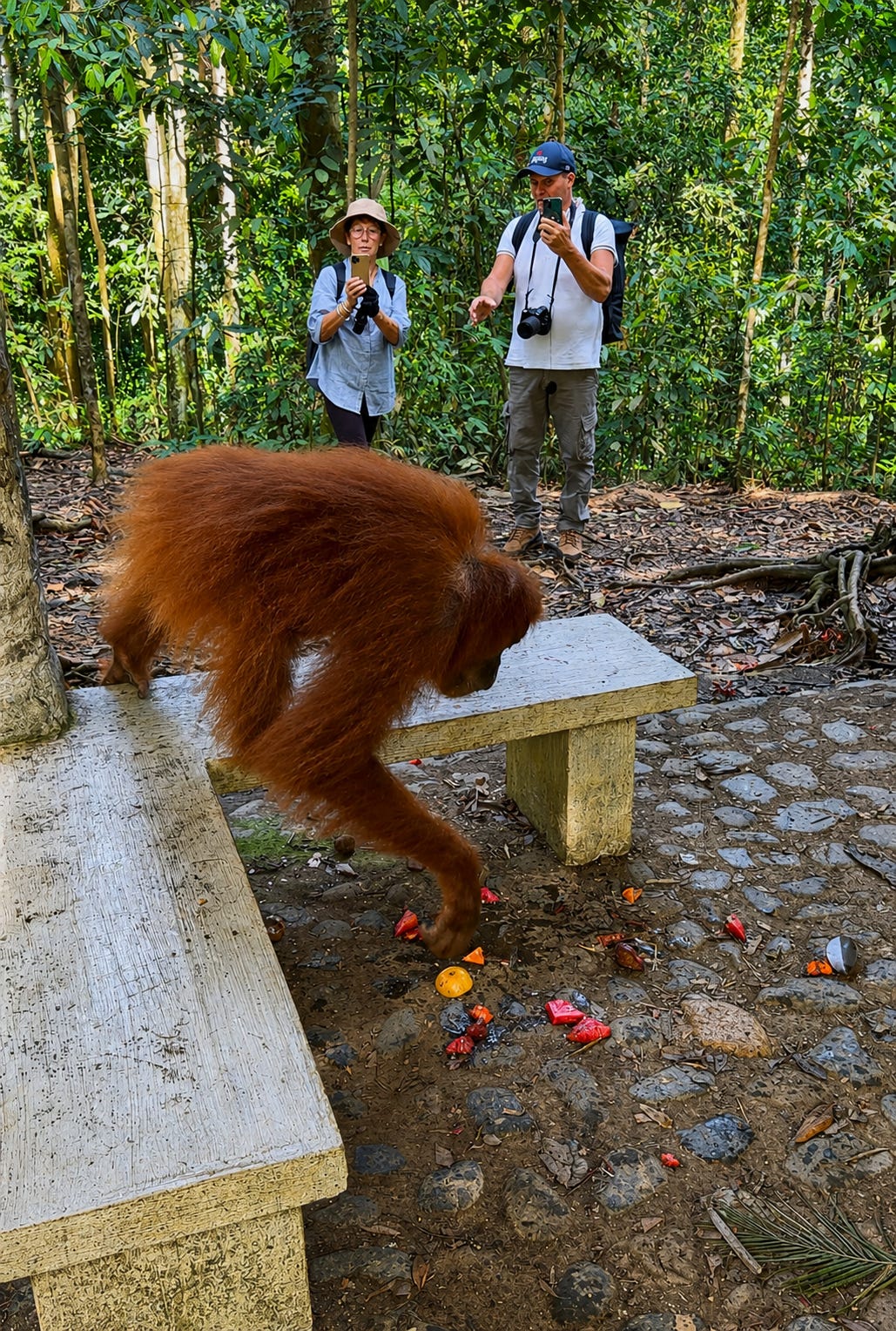
The feeding typically happens in two ways.
The first is indirect, but it is still wrong. Guides throw fruit scraps into the forest after meals, and orangutans learn to search for and consume these discarded food items.
The second is far more deliberate and far more common. Guides actively place bananas and other fruits at the base of trees or along trails to lure orangutans down from the canopy and closer to tourists, creating an encounter that would otherwise be unlikely to happen naturally. The orangutan climbs down, grabs the bait, and suddenly guests find themselves just a few meters away from one of the world’s most iconic great apes. To many visitors, it feels like an incredible wildlife experience.
But what they are actually witnessing is a wild animal being conditioned by food.
The irony is that most visitors have no idea it is happening. They assume they are seeing natural behavior when, in reality, the moment has been manipulated.
The consequences go far beyond creating a misleading wildlife experience.
Feeding changes behavior. Orangutans that learn to associate people with food begin spending more time around humans and less time behaving naturally. It increases the likelihood of disease transmission between humans and great apes, something conservationists have worried about for decades. It can alter movement patterns, social interactions, and feeding ecology. Over time, it creates dependency and reduces the very wildness that people come to see.
For me, it also destroys something less tangible but equally important.
The magic.
There is nothing quite like earning a truly wild encounter. Trekking through the rainforest, searching for hours, and then suddenly finding an orangutan feeding high in the canopy. Knowing that every behavior you are witnessing is entirely natural. Knowing that the animal chose to be there.
That is what makes wildlife encounters meaningful.
When food is involved, the moment changes completely. Instead of feeling privileged to witness nature, you are watching a performance shaped by human interference.
The most frustrating part is that there appears to be very little enforcement.
The rules already exist.
Everyone knows the rules.
Yet many guides continue feeding wildlife because there are few consequences and because close encounters often lead to larger tips from visitors who don’t understand what is happening behind the scenes.
What makes this even more frustrating is that feeding orangutans is completely unnecessary. Gunung Leuser is one of the most biologically rich rainforests on Earth, with an abundance of natural food sources including figs, fruits, leaves, bark, flowers, and insects. Orangutans have survived here for thousands of years without human assistance. They do not need bananas from guides to find food.
This is not a problem that can be solved by blaming a handful of individuals. Many local guides depend on tourism to support their families. The incentives are simply pointing in the wrong direction.
If we want to improve the situation, we need to address those incentives.
We need stronger enforcement of existing regulations.
We need better education for guides and visitors about why feeding wildlife is harmful.
We need tour operators to take a firm stance against feeding.
We need travelers to ask questions and choose responsible guides who prioritize ethical wildlife viewing over guaranteed close encounters.
And we need more awareness within the broader wildlife photography and tourism community.
Every person who visits Gunung Leuser has a choice.
Do you want to see a wild orangutan behaving naturally?
Or do you want to see an orangutan that has been lured closer with food?
The future of wildlife tourism depends on choosing the first option.
Gunung Leuser remains one of the greatest places in the world to see wild orangutans. The rainforest is extraordinary. The wildlife is extraordinary. The people who work hard to protect it are extraordinary.
That is exactly why this issue matters.
People protect what they love. But before people can protect wildlife, wildlife must remain wild.
If we truly care about orangutans and their future, we need to stop rewarding the practices that are turning wild encounters into staged ones and start supporting the guides and operators who are doing things the right way.
Because the most memorable wildlife encounters are the ones that cannot be guaranteed, manipulated, or bought. They are earned through patience, respect, and a willingness to let the wild reveal itself on its own terms. Those are the moments that stay with us for a lifetime, not because we created them, but because, for a brief moment, we were welcomed into a story much larger than our own.
Quote of the Week
The best way to not feel hopeless is to get up and do something.
— Barack Obama
Tour Updates
As a reminder, we have just had a few spots open up on our August 16-20, 2026 Alaska Bear Camp tour. If you love bears and want one of the best bear-viewing experiences on the planet, this is the trip for you.
Today is our last full day in Sumatra with the orangutans before beginning the long journey home. Moments like this always make me reflective. The older I get, the more I realize that the things I value most are not possessions or achievements, but experiences that challenge me, inspire me, and deepen my appreciation for life. Standing in a rainforest with wild orangutans is one of those experiences. It reminds me how much there is still to learn, how much there is still worth protecting, and how fortunate we are to share this planet with such extraordinary creatures. If there is one lesson travel has taught me, it is that a meaningful life is built through curiosity, gratitude, and a willingness to keep exploring. The world has a remarkable way of rewarding those who remain open to it, and some of life’s greatest gifts are found far beyond our comfort zones, waiting in places we have never been and experiences we have yet to imagine.
2026 Tours with Availability
Aug 16-20: Alaska Bear Camp (4 spots)
Sept 2-9: Kenya Big Cat Safari (2 spots)
Sept 13-21: Brazil Jaguars (2 spots)
*NEW Nov 24-30: Mountain Gorillas (3 spots)
*NEW Nov 30 – Dec 5: Mountain Gorillas (3 spots)
Feel free to reply to this email with any questions, feedback, or just to share your latest wildlife photos. Feel free to share this message with fellow nature lovers, too—let’s grow this community together!
Thank you for being a part of The Wildlife Collective community. Stay tuned for more updates, conservation news, and incredible wildlife encounters!
Best regards,
Zac Mills
The Wildlife Collective