
I’m writing this from Nunavut, where I’ve spent the past several days watching polar bears in the wild. It is difficult to describe the feeling of being in their world. Seeing a bear moving across the tundra, following the coastline, or resting in the snow is something I wish everyone could experience.
But there’s something about being here that has been bothering me.
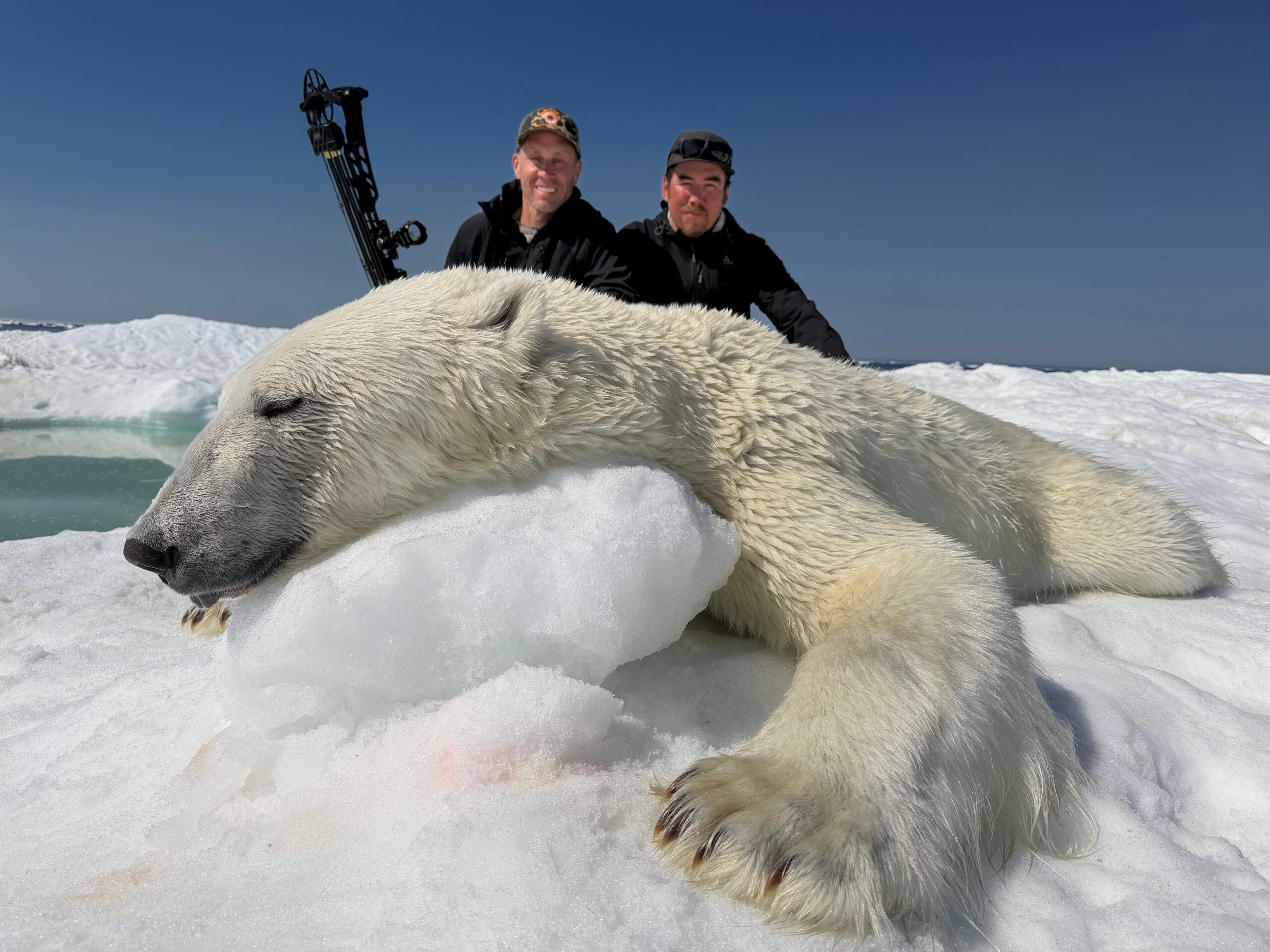
In parts of the Canadian Arctic, someone can pay tens of thousands of dollars to come here and shoot one of these animals. Not because they need the meat. Not because the bear poses a threat. But because they want a polar bear skin or skull to take home.
I find that appalling.
And I think it’s time we had a much more uncomfortable conversation about polar bear trophy hunting in Canada.
First, we need to talk about culture
This is an incredibly sensitive subject, and I understand why.
Inuit have hunted polar bears for thousands of years. Hunting is part of their culture, their history, and their relationship with the land. It has provided food, clothing, and materials, and remains important to many communities today.
I have enormous respect for that history and for the knowledge Inuit hunters have of these animals. I also recognize that, as someone visiting the Arctic, I have a very different relationship with this place than the people who have lived here for generations.
But I think we need to distinguish between traditional subsistence hunting and commercial trophy hunting.
Under Nunavut’s polar bear co-management system, communities receive polar bear harvest allocations, and some choose to use part of those allocations for guided sport hunts. Wealthy visitors can pay to hunt a bear with local guides. The animal counts against the existing community quota, and the meat can remain in the community.
I understand the economics. These hunts can generate important income in communities where jobs are scarce and the cost of living is extraordinarily high.
But I still cannot understand why we are allowing people to travel to the Arctic to kill polar bears for trophies.
And something happened here two days ago that brought this issue into particularly sharp focus.
Here in Arviat, the community held its annual draw for polar bear hunting tags. Thirteen tags were drawn. Thirteen polar bears whose lives will now end.
What disturbed me most was what I learned happened next.
The first five people whose names were drawn were immediately offered $10,000 each for their tags by a trophy hunting operator, who could then resell those hunting opportunities to paying sport hunters.
Think about that for a moment. A polar bear hunting tag was worth $10,000 almost the moment it was drawn.
And I want to be very clear about something. I do not blame the people receiving those offers. From what I’ve been told, economic opportunities here are extremely limited. In a remote Arctic community where the cost of living is extraordinarily high, $10,000 represents a huge financial windfall. It could make a meaningful difference to someone’s family.
If I were in their position, facing those same economic realities, I can understand why accepting that money would be an easy decision.
My problem isn’t with the people accepting the money. It’s with a system that makes killing a polar bear such a valuable economic opportunity in the first place.
We have created a market in which the right to kill one of the Arctic’s most extraordinary animals can be bought and sold, with commercial operators able to profit from arranging its death.
And here I am, spending my days watching those very same animals alive in their natural habitat, bringing visitors who have travelled thousands of miles for the privilege of seeing them.
The contrast could hardly be greater.
Respecting Indigenous culture and questioning commercial trophy hunting should not be mutually exclusive.
And we should be able to discuss this without immediately turning it into a debate about whether outsiders have the right to criticize Indigenous traditions.
I’m not arguing that Inuit should lose their hunting rights. I’m asking whether we can create a future where selling a polar bear’s life to a trophy hunter is no longer considered a necessary economic opportunity.
Look at Churchill
One of the most interesting examples is right here in northern Canada.
Churchill, Manitoba, has built an entire tourism economy around polar bears. Every autumn, thousands of people travel there from around the world, spending substantial amounts of money on accommodation, guides, transportation, restaurants, and wildlife experiences.
And the economic numbers are remarkable.
According to a 2024 report from Travel Manitoba, Churchill’s tourism industry contributed an estimated $99 million to Manitoba’s GDP, supporting approximately 1,395 direct and indirect jobs.
Those figures include Churchill’s other attractions, such as beluga whales and northern lights, but polar bears remain central to the town’s international reputation.
People aren’t travelling to Churchill to shoot polar bears. They’re travelling there to see them alive.
And that distinction has enormous economic implications.
Polar bear hunting is prohibited throughout Manitoba. Churchill does not receive a separate trophy-hunting quota, although bears belonging to the same Western Hudson Bay population can be harvested in neighbouring Nunavut under a different management system.
So we have this extraordinary situation where polar bears can be protected from hunting on one side of a jurisdictional boundary and legally harvested on the other.
The bears, of course, have no idea where that boundary is.
Churchill has shown what is possible when wildlife becomes the foundation of a tourism economy. A bear might be seen by hundreds of visitors over its lifetime. Those encounters support guides, hotels, local businesses, and families.
Compare that with a trophy hunt.
A hunter pays to kill a bear, and that particular animal’s contribution to the local economy ends.
Of course, it’s not quite that simple. Churchill has infrastructure, established tourism operators, and relatively accessible transport connections. Many northern communities have none of those advantages. And there are real costs and environmental impacts associated with tourism.
But surely this is where we should be directing our efforts.
Why aren’t we investing much more heavily in helping Inuit communities build their own polar bear tourism businesses?
Why aren’t governments and conservation organizations working together to make living polar bears more economically valuable to the communities that share their home?
Why do we accept that trophy hunting is an important source of income instead of asking how we can replace that income with something better?
We’ve seen traditions change before
I’ve spent a considerable part of my life in Kenya, where I work closely with Maasai communities.
Historically, killing a lion was an important rite of passage for some Maasai warriors. It could bring recognition, prestige, and respect. It was deeply connected to ideas of courage and becoming a man.
For generations, that was part of the culture.
But things have been changing.
Through Maasai-led conservation programs, including Lion Guardians, former lion hunters have become lion protectors. Young warriors can now gain recognition through conservation rather than killing.
This hasn’t happened everywhere, and lion killing hasn’t disappeared entirely. But the shift is remarkable.
Think about what that means.
A tradition that once celebrated killing one of Africa’s most magnificent predators has, in some communities, evolved into one that celebrates protecting it.
And the Maasai haven’t stopped being Maasai.
Their culture hasn’t disappeared. Their identity hasn’t been erased.
They have adapted.
And sometimes that evolution can benefit both people and wildlife.
We don’t have to look as far as Africa
There’s another example much closer to home, in British Columbia’s Great Bear Rainforest.
In 2022, the Gitga’at and Kitasoo Xai’xais First Nations successfully pushed for a ban on black bear hunting across more than 8,000 square kilometres of their traditional territories.
The goal was to protect spirit bears, the rare white-coated black bears that hold enormous cultural significance for these communities.
Although killing a white spirit bear had long been illegal, black bears carrying the recessive gene responsible for their white coats could still be hunted. The Nations recognized that protecting spirit bears meant protecting the wider bear population.
What I find particularly interesting is that these communities have also developed successful bear-viewing tourism businesses. People travel from around the world to see spirit bears in the wild, generating income for local guides, accommodation providers, and other businesses.
This wasn’t a conservation decision imposed by outsiders. It was driven by Indigenous communities themselves, working with the provincial government to protect animals that are both culturally and economically important to them.
I’ve been fortunate enough to spend time photographing spirit bears in the Great Bear Rainforest, and I’ve seen firsthand how much these animals mean to the people who live there.
It’s an example that deserves far more attention.
Here are Indigenous communities that have made protecting bears a priority, while helping build an economy around people coming to see them alive.
So when people argue that questioning polar bear trophy hunting is somehow disrespectful to Indigenous culture, I think we should look at what the Gitga’at and Kitasoo Xai’xais have achieved.
Indigenous culture and wildlife conservation are not opposing forces. In many places, Indigenous communities are leading the conservation work.
And if communities in the Great Bear Rainforest can help change the way bears are valued and protected, surely it’s worth asking whether something similar could happen in the Canadian Arctic.
The argument that trophy hunting helps conservation
I hear this argument frequently, particularly when discussing trophy hunting in Africa.
The claim is that hunting generates money, the money benefits communities, and communities therefore have an incentive to protect wildlife.
In fact, the Government of Canada’s own assessments of polar bear harvests emphasize the economic benefits of guided hunting for northern Indigenous communities.
But I think we should be asking a much more ambitious question.
Why should killing an animal be the economic incentive for protecting it?
Why is that the best we can come up with?
Polar bears are already facing enormous challenges from climate change. Declining sea ice is changing where they can hunt, how long they can feed, and how much energy they must expend to survive.
The IUCN Polar Bear Specialist Group tracks the status of the Arctic’s 20 recognized polar bear subpopulations. The situation varies across populations, and hunting is not the primary threat to polar bears globally. Climate change is.
But that doesn’t somehow make trophy hunting acceptable.
I often hear that polar bear hunting is sustainable because quotas are established through wildlife management systems that consider scientific research and Inuit knowledge.
Sustainability matters. But the reality is that we lack sufficient data to confidently assess the trends of many polar bear populations.
We also seem to have become so focused on how many animals we can sustainably remove from a population that we rarely stop to question why we’re removing them in the first place.
For subsistence hunting, there is a cultural and practical answer.
For trophy hunting, the answer is that someone wants to kill a polar bear.
I don’t find that a particularly compelling justification.
What are we actually celebrating?
This is the part I struggle with most.
A polar bear is an extraordinary animal. It can travel enormous distances, survive months with little food, navigate shifting sea ice, and hunt seals in one of the harshest environments on Earth.
Its entire life is about survival.
Then someone arrives with a rifle, pays for a guide to find one, shoots it, and poses beside the body.
And we’re supposed to admire that?
What exactly is the achievement?
The hunter hasn’t demonstrated an ability to survive in the Arctic like a polar bear. They haven’t outsmarted an animal on equal terms. They have paid for an opportunity to kill it using modern equipment and the expertise of people who know the land.
I find the photographs particularly disturbing. Someone smiling beside a dead polar bear, celebrating the loss of an animal that had absolutely no reason to die.
I know that people who support trophy hunting will disagree with me. They’ll point to the money it generates, the legality of the hunt, the role of local guides, and the fact that the animal is counted within an established quota.
But none of that changes how I feel about the person who chooses to pull the trigger.
You travelled all that way, spent all that money, and had the privilege of encountering one of the world’s most remarkable animals.
And you chose to kill it.
I will never understand that.
Northern communities deserve better options
I don’t want this article to become another example of someone from southern Canada telling people in the North what they should or shouldn’t do.
That would miss the point entirely.
The Arctic has a long history of outsiders making decisions for Indigenous communities, often with terrible consequences. Any changes to polar bear hunting need to be led by the communities themselves.
And the economic realities are important.
It’s easy to sit in a comfortable home in southern Canada and say that trophy hunting should end. It’s much harder to replace the income from those hunts in a remote community where groceries cost several times what they do farther south.
The $10,000 offers I learned about here in Arviat illustrate that reality perfectly.
For someone with limited opportunities to earn a substantial income, turning down that kind of money would be a significant sacrifice. We cannot expect communities to give up economic opportunities simply because people like me find the underlying activity morally unacceptable.
If we want change, we need to help make it possible.
That means real investment. Not another conservation campaign that raises money and achieves very little on the ground.
I’m talking about supporting Inuit-owned tourism businesses, training local wildlife guides, improving infrastructure, investing in accommodation and transportation, and helping communities reach international visitors.
It also means recognizing that tourism won’t be the answer everywhere. Some communities are too remote, or have conditions that make regular wildlife viewing impractical. Other forms of conservation employment, Indigenous guardian programs, and long-term funding for community-led wildlife management could be part of the solution.
And if we genuinely believe that polar bears are worth protecting, perhaps governments and conservation organizations should be willing to invest more in the communities doing that protecting.
I would much rather see money flowing into northern communities because they are keeping polar bears alive than because they are helping someone kill one.
It’s time to change the conversation
I realize this article will upset some people.
Trophy hunters will disagree with me. Some people will argue that I don’t understand northern culture or the economics of hunting. Others will say that as a wildlife tourism operator, I have a financial interest in promoting tourism over hunting.
That’s fair to question. I do earn my living taking people to see wildlife, and I believe responsible wildlife tourism can be an important force for conservation.
But my opposition to trophy hunting goes well beyond my business.
I have spent years watching bears in Alaska, Canada, and elsewhere. I’ve watched mothers with cubs, bears fishing for salmon, and polar bears making their way across the frozen Arctic landscape.
The more time I spend with these animals, the less patience I have for the idea that killing one for personal satisfaction is something we should celebrate.
And the fact that a practice has a long history, or generates income, doesn’t mean it should continue forever.
We have changed our relationship with wildlife before.
The Maasai example shows that cultural practices can evolve through community leadership. The Gitga’at and Kitasoo Xai’xais Nations show how Indigenous-led conservation can protect bears while supporting local economies. Churchill shows that polar bears can generate substantial economic value simply by being alive.
None of these examples provides a ready-made solution for every community in Nunavut. But together, they give us a reason to ask whether a different future is possible.
I believe it is.
I want to see northern communities prosper. I want Inuit knowledge and culture to be respected and celebrated. I want local people to benefit financially from the extraordinary wildlife around them.
And I want polar bear trophy hunting to end.
Those goals shouldn’t be in conflict.
We are living at a time when polar bears face an increasingly uncertain future. We know the sea ice is changing. We know these animals face challenges that will only become more difficult in the coming decades.
Surely the least we can do is stop treating them as trophies.
A polar bear should be worth more to us alive than hanging on someone’s wall. And if our economic system doesn’t reflect that, perhaps it’s the system that needs to change.
Quote of the Day
In our indigenous culture, you just don’t shoot something for sport.
— Doug Neasloss, Kitasoo Xai’xais First Nation, British Columbia
Thank you for being part of The Wildlife Collective. Together, we are helping build a deeper connection between people and the natural world while supporting the conservation of wildlife and wild places. Stay tuned for more stories from the field, conservation news, photography tips, and unforgettable wildlife encounters from around the globe.
Until next time, keep exploring, keep learning, and keep falling in love with the wild.
Zac Mills
The Wildlife Collective