
Today I had one of the best wildlife moments of my life.
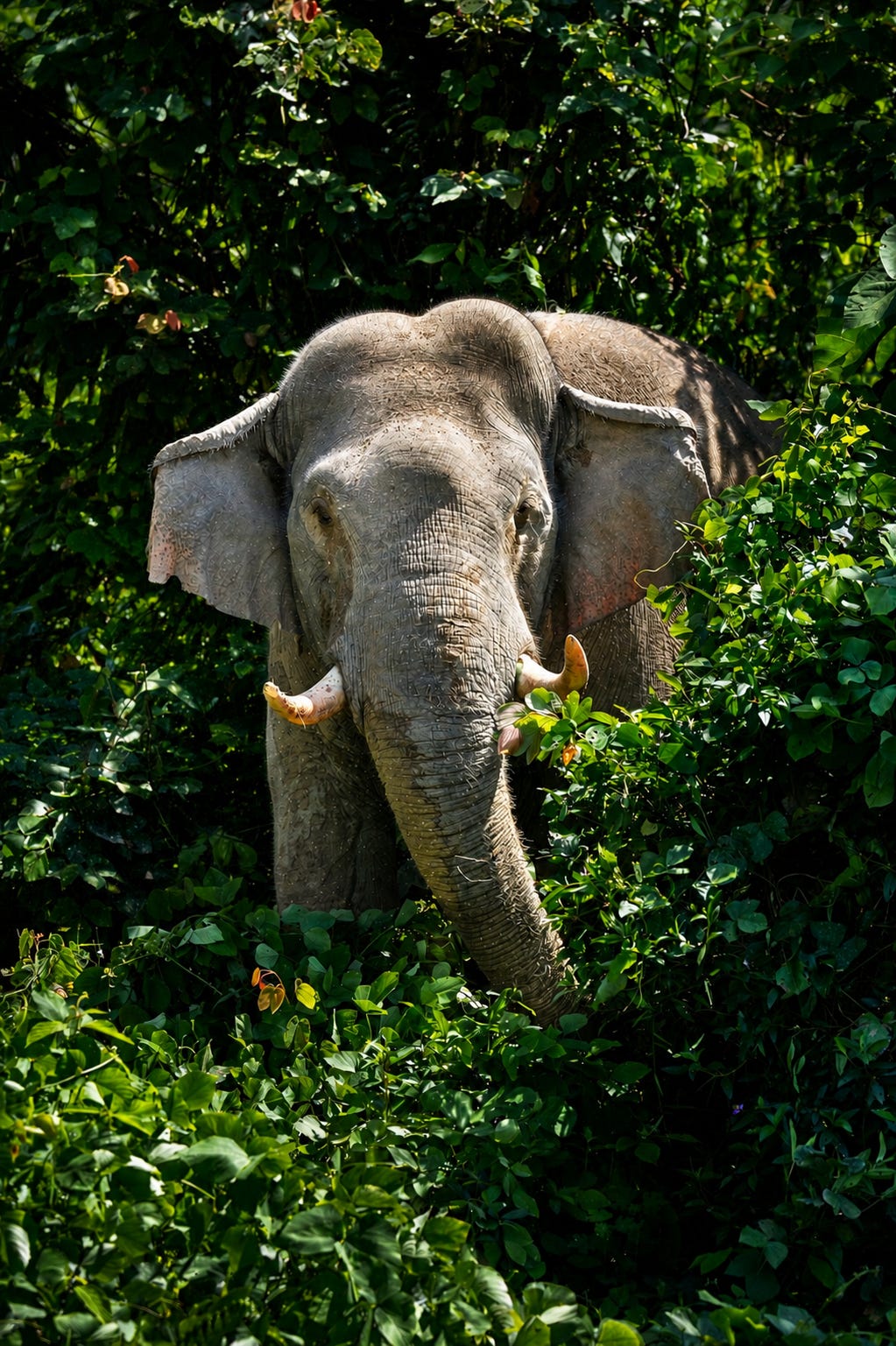
Wild Sumatran elephants are incredibly rare. Fewer than 2,500 are believed to remain in the wild and their numbers continue to decline due to habitat loss, palm oil expansion, and conflict with humans. They are a subspecies of the Asian elephant, smaller than African elephants but still absolutely enormous animals capable of eating more than 100 kilograms of vegetation a day. Compared to African elephants, they have smaller rounded ears, smoother skin, and only some males develop large visible tusks. Sumatran elephants are also known for being slightly smaller and darker than other Asian elephant populations, adaptations that suit the dense tropical rainforests they call home. They are intelligent, emotional, highly social, and critically important to the rainforest ecosystem. Yet despite all of that, most people who visit Sumatra will never see one in the wild.
Yesterday, we received word that there were wild elephants somewhere about 1–2 hours away from us. Darma asked me if I wanted to go and try for them and I immediately said yes. I honestly didn’t know what to expect. I didn’t know much about the experience, how realistic it was, or if we would even find them at all. But I knew I wanted to go.
We left at 7am and started driving north along the border of Gunung Leuser National Park. Along the way we stopped to grab lunch for later and continued driving through endless rows of palm oil plantations. It was one of those stark reminders of just how fragmented this landscape has become. Rainforest. Plantation. Rainforest. Plantation. A constant push and pull between the wild and human expansion.
About two hours later we arrived.
We got out of the vehicle and I quickly realized we were standing in a government-owned palm oil plantation right beside the forest edge. We met our local guide and off we went on foot.
Being in the border zone, there was no overhead cover like you get deep in the rainforest. No canopy to shield you from the heat. The sun was intense and it felt much hotter than trekking for orangutans. Within just a few minutes of walking, we spotted our first elephant several hundred meters away.
I was already amazed.
Just seeing one felt special.
We slowly repositioned and managed to get within roughly 100 meters before the elephant disappeared back into thicker cover. I was thrilled. I honestly thought that might be the moment of the day.
But the best was still to come.
We continued walking and eventually went to try for another elephant. This time we got incredibly close. Around 20 meters away.
On foot.
It is hard to put into words what that feels like. The elephant was partially obscured behind a bush but I could see it looking directly at me. I remember feeling completely on edge. Adrenaline. Respect. Awe. Fear. All at once.
I shifted a few steps to my left to get a clearer angle and that’s when everything changed.
The elephant bluff charged me.
It happened so fast.
With bears, you stand your ground.
With elephants, you run.
And I ran.
The whole thing only lasted a few seconds and ended well, but it completely took my breath away. It was one of those moments where your body reacts before your brain even catches up. Pure instinct. Pure wildness. A moment I will never forget for the rest of my life.
After that encounter, we continued tracking elephant footprints through the plantation edge and eventually saw two more elephants. Four elephants total.
By this point the sun was brutally hot, so we headed back to the vehicle, sat together, ate lunch, and just reveled in what we had experienced.
Then we made the long drive back to the lodge.
And honestly, I am still on cloud nine.
It’s moments like this that stay with you forever. Moments that remind you how wild and beautiful this planet still is. Moments that make you feel part of something bigger in the best possible way.
Sumatra is one of the most extraordinary places I have ever experienced. Orangutans swinging through ancient rainforest. Tigers moving unseen through the jungle. Hornbills flying overhead. Elephants surviving along fractured forest edges beside endless palm plantations. It is breathtaking, diverse, alive, and at the same time, incredibly fragile.
You can feel both realities everywhere here. The beauty and the loss. The hope and the pressure.
Experiences like today only deepen my desire to keep exploring this planet, to keep searching for these moments of connection with the wild, and to keep telling stories that matter. Stories that help people care. Stories that inspire conservation. Stories that remind us what is still left to protect before it is gone.
When I was young, I never could have imagined that one day I would be tracking wild elephants on foot in Sumatra. Yet somehow, here I am, living that life.
And more than ever, I feel grateful for this path, for these experiences, and for the opportunity to use storytelling in service of something bigger than myself.
Because the wild matters.
And these moments are worth fighting for.
Quote of the Week
The Earth has music for those who listen.
— George Santayana
Tour Updates: You can track elephants on foot
We will now be incorporating tracking wild Sumatran elephants on foot into all of our future Sumatran orangutan tours. This is an incredibly exclusive experience with access arranged just for our small group, allowing us to quietly track and observe these endangered elephants in the wild alongside local experts. We’re always trying to push a little further to find the most meaningful and immersive wildlife experiences possible, the kinds of experiences that still feel truly wild and deeply connected to the animals and places themselves, and adding wild elephant tracking in Sumatra feels exactly like that. Very few people ever get the opportunity to experience these elephants this way. I’m currently finalizing several departures for next March, April, and May 2027. Sumatra has become one of my favorite places on the planet. The combination of ancient rainforest, orangutans, elephants, incredible biodiversity, and the feeling of wilderness here is unlike anywhere else I’ve experienced. If joining us in Sumatra is something that interests you, please let me know.
2026 Tours with Availability
Sept 2-9: Kenya Big Cat Safari (2 spots)
Sept 13-21: Brazil Jaguars (2 spots)
*NEW Nov 24-30: Mountain Gorillas (3 spots)
*NEW Nov 30 – Dec 5: Mountain Gorillas (3 spots)
Feel free to reply to this email with any questions, feedback, or just to share your latest wildlife photos. Feel free to share this message with fellow nature lovers, too—let’s grow this community together!
Thank you for being a part of The Wildlife Collective community. Stay tuned for more updates, conservation news, and incredible wildlife encounters!
Best regards,
Zac Mills
The Wildlife Collective