
Hi, this is Cassie.
I’ve just returned from two weeks in North Sumatra. My first journey to this corner of the world, and my first time encountering orangutans in the wild. Even as I write these words, I can still feel the echo of the rainforest around me: the low hum of cicadas, the distant calls of macaques, the rhythm of rain on broad jungle leaves.
The forest here is dense and ancient, tangled with vines and history. It is the last place on Earth where tigers, elephants, rhinos, orangutans, sun bears, and clouded leopards still share the same canopy. And yet, what drew me most deeply, what has stayed with me most fiercely, was the moment I first saw her: a mother orangutan, high in the trees, her baby clinging tightly to her chest.
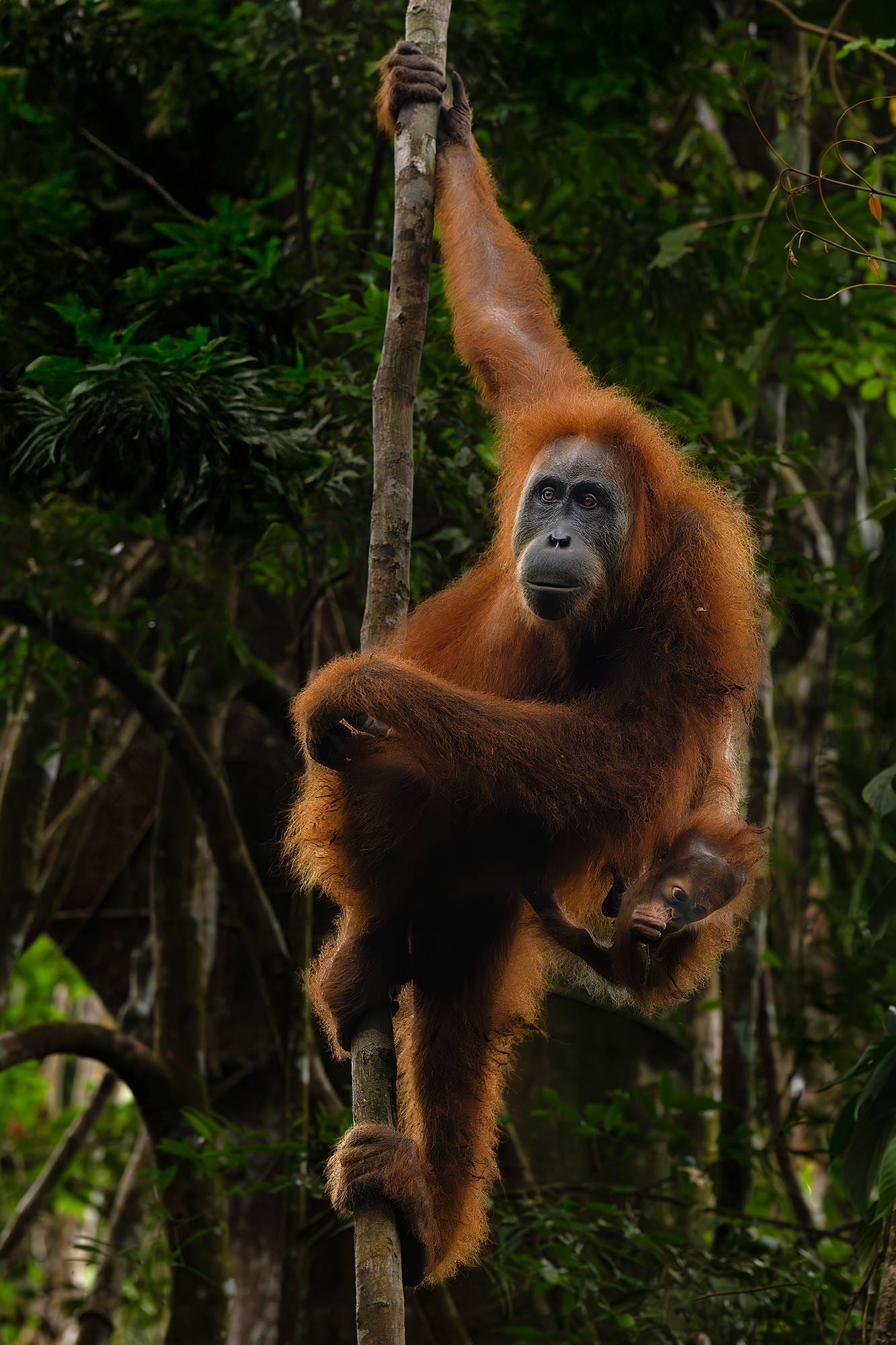
She moved with such quiet purpose, swaying effortlessly from branch to branch. I stood below, hardly breathing, watching as sunlight filtered through the canopy and lit up her auburn hair like fire. Her baby peeked out; curious, wide-eyed, full of wonder. In that moment, I felt like the forest itself had paused. Nothing I had read or prepared for compared to the stillness, the beauty, the deep sense of privilege in simply being there. And then, almost as if she had chosen to let us in, she began to swing lower, her long arms guiding her gently down through the trees. She passed right by me, close enough that I could hear the soft rustle of her movement through the leaves. Her baby clung to her chest, impossibly small, still pink in the face, nestled so naturally against her. And then, she looked at me. Her eyes met mine, steady and unhurried. In that brief moment, I wasn’t looking at a wild animal. I was looking at a mother with her child. The tenderness between them, the quiet strength in her grip, the way she cradled him, it all felt deeply familiar. I felt it in my chest. It was as human a moment as I’ve ever known.
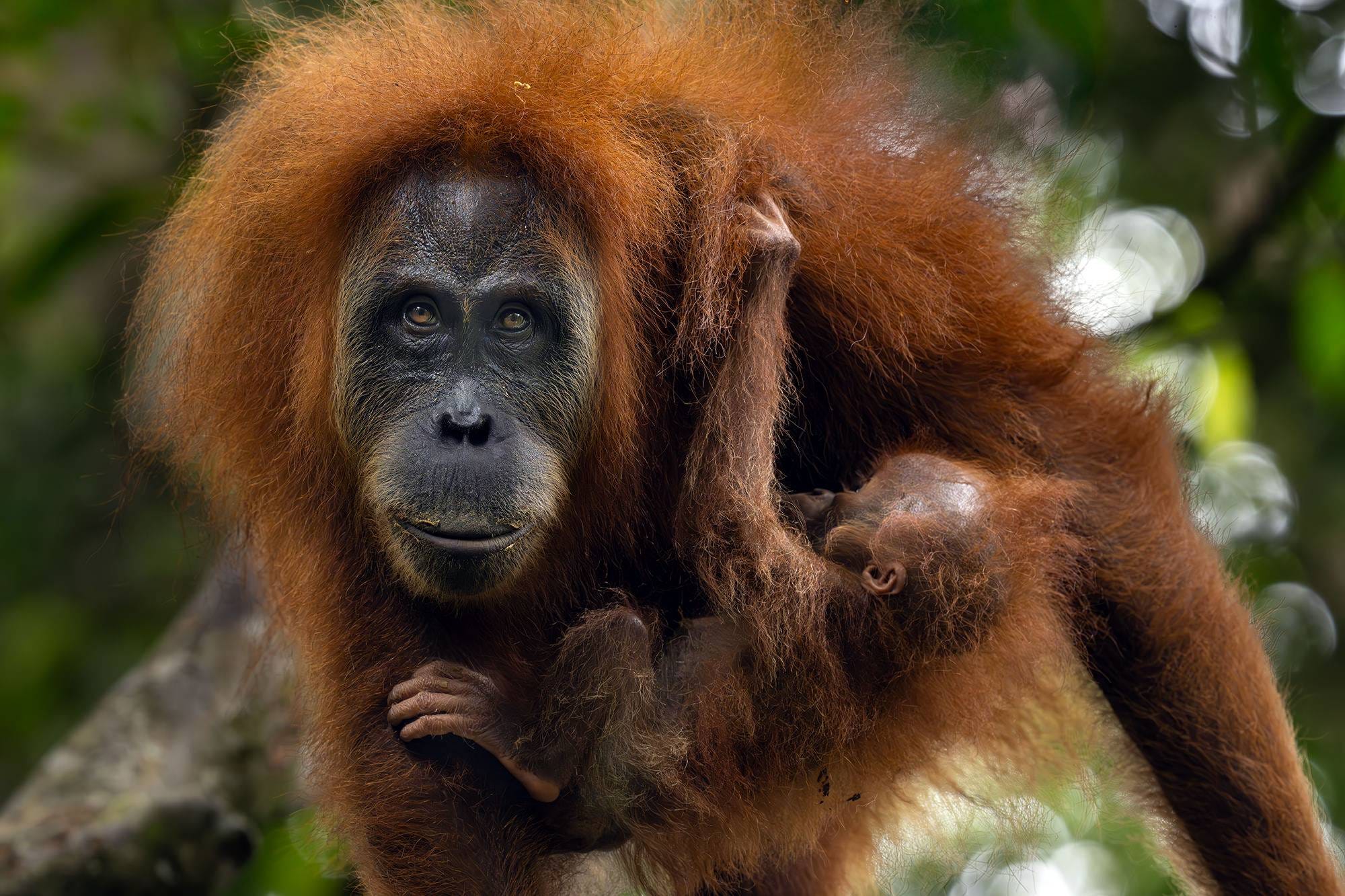
There’s something about watching wild orangutans that gently humbles you. It’s a quiet reminder that we’re not set apart from nature, we belong to it. And somehow, in their eyes, we see a reflection of ourselves. In their presence, I found something rare: humility, awe, and a kind of wordless connection that stayed with me long after she disappeared into the trees.
In recent months, I’ve tracked bears through the highlands of Ecuador and along Alaska’s remote coastlines. I’ve followed pumas across the windswept plains of Patagonia and watched lions move through the golden light of the Masai Mara. Each experience was unforgettable in its own way; raw, wild, and powerful. But my time with the orangutans stood apart. It felt more personal. Orangutans share nearly 97% of our DNA, and when you’re with them, you feel it. You see it in their eyes. There is an intelligence there, not just instinct or curiosity, but something that feels familiar. The way they cradle their infants, the way they move through the trees, even the way they pause and look at you, it all feels strikingly human. No other animal I’ve spent time with has ever made me feel so seen. And maybe that’s what makes the experience so unforgettable. It doesn’t just feel like observing wildlife. It feels like being with someone who understands when they are looking into your eyes.
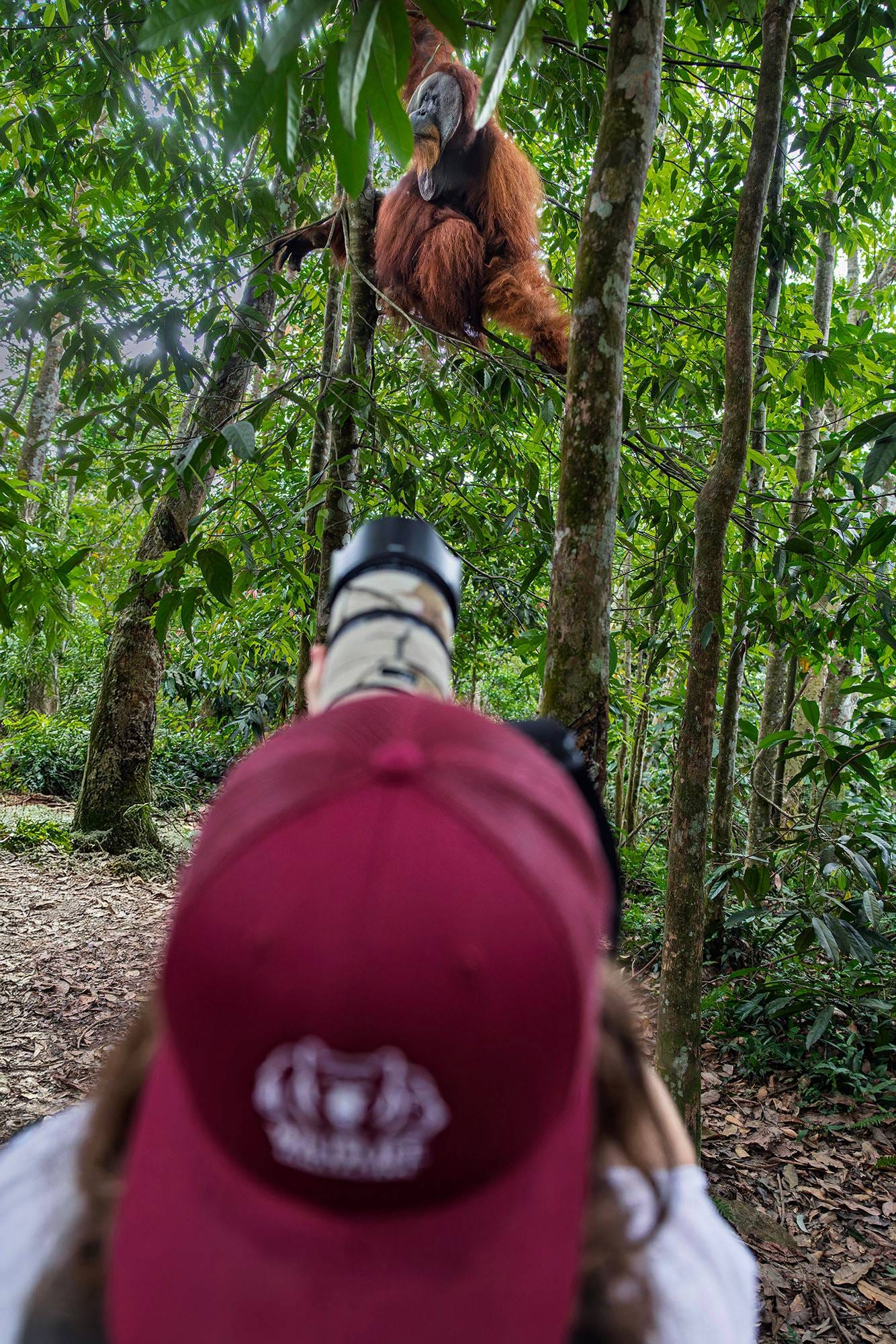
This experience wouldn’t have been possible without the local guides, guys who knew the jungle like the back of their hand. They moved through it with quiet confidence, able to hear and see things we couldn’t, feeling the forest with their whole bodies. But what made them truly exceptional, what set them apart from any other team in the park, was how they worked with photographers. They didn’t just find orangutans; they anticipated their movements, positioned us perfectly with the light, and helped us avoid shooting into white sky. They understood how to move, when to wait, and how to read both the forest and the animal’s behavior. Following their lead through the jungle wasn’t just helpful, it elevated the entire experience.
We’re proud to partner with two organizations doing meaningful, on-the-ground work here in Sumatra; Nature for Change and the Sumatran Orangutan Society (SOS). Nature for Change works closely with local communities, helping restore forest along the edge of Gunung Leuser National Park and offering real alternatives to palm oil. SOS focuses on protecting existing rainforest, replanting what’s been lost, and raising awareness about why these efforts matter. Together, their work is making a real difference, not just for the orangutans, but for the future of the entire ecosystem. And by supporting them, we’re not just observing this place, we’re helping to protect it.
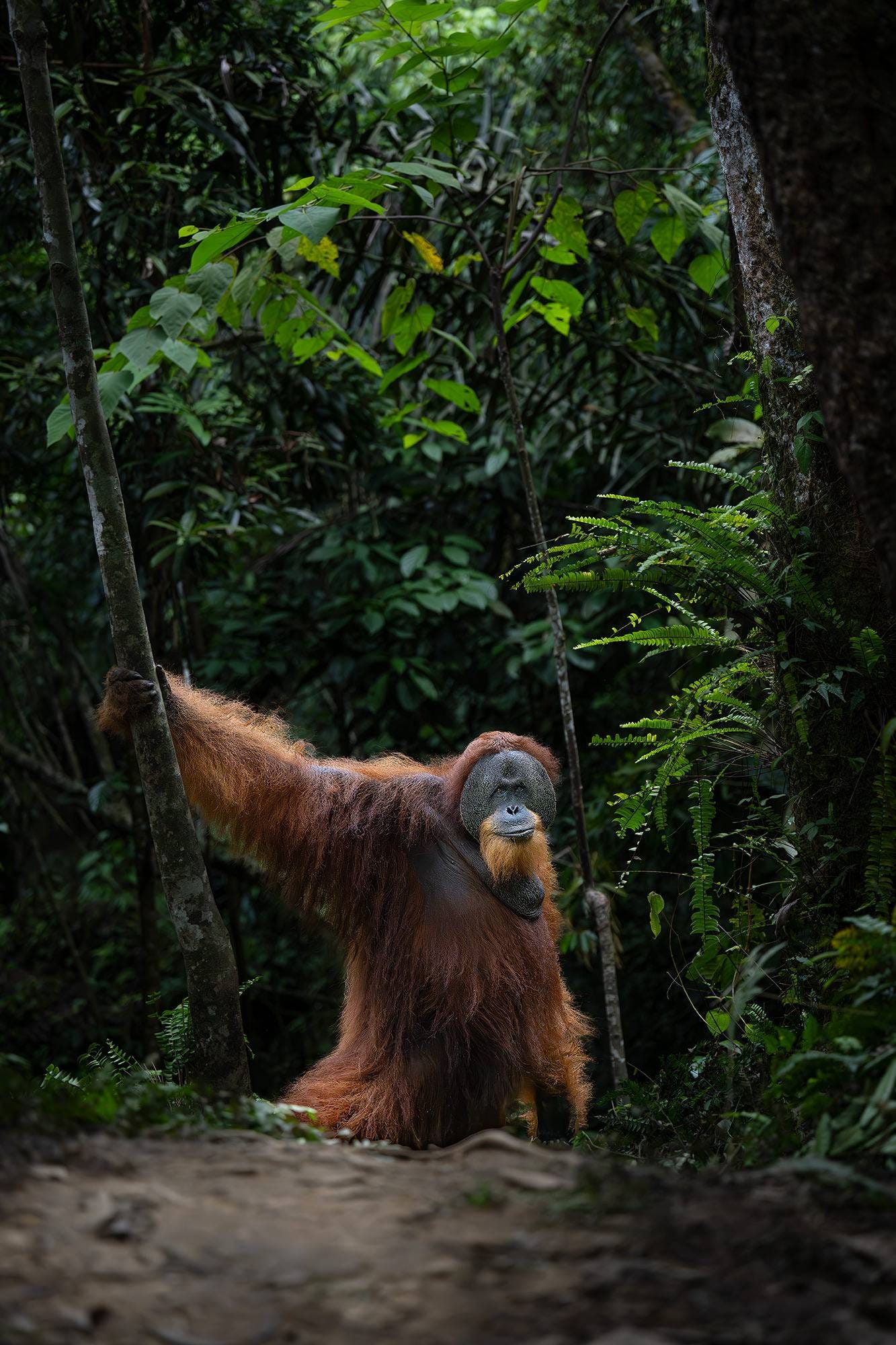
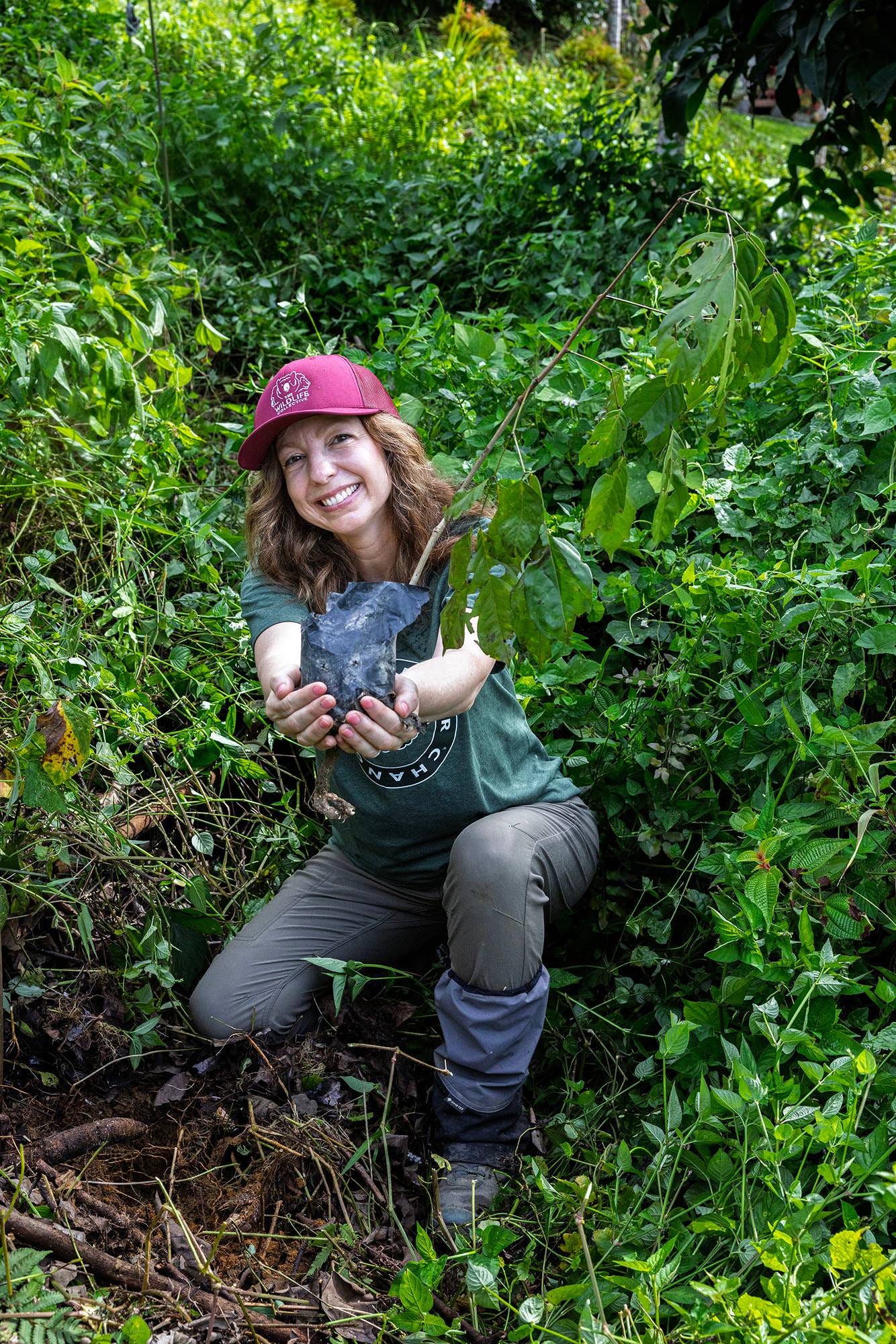
During our tours we help restore the buffer zones by replanting them with native fruit trees like durian, rambutan, and jengkol. These trees don’t just help the forest recover, they offer families a sustainable alternative to palm oil. Instead of cutting more forest, local people can earn a living by harvesting and selling fruit from these trees, allowing the rainforest to remain standing. These trees will help create safe, living corridors where animals can move freely again. It’s not about choosing one or the other, it’s about creating a future where both can exist, side by side.
Planting those trees felt meaningful. A way to give back to a place that had given us so much. One tree, one handful of soil, a quiet reminder that even the smallest acts can help mend the bond between people and the wild.
As I left the forest, I didn’t feel ready to go, but I felt deeply grateful. Grateful to have seen what I saw, to have been welcomed into that world, and to now carry a piece of it with me. I hope you too get to experience this for yourself. Because once you’ve stood beneath the emerald canopy, and met the gaze of something wild and ancient, you don’t just leave the forest, you carry its stillness, its wonder, its truth. It changes you quietly, profoundly, reminding you of your place in the living world and awakening a deeper sense of care, not just for the forest and its creatures, but for the wild places within yourself.
New 2026 Orangutan Tour Dates!
Our initial orangutan tours for 2026 sold out, so we’re happy to share that we’ve added two more opportunities to join us:
These small-group adventures take you deep into the rainforest, where you’ll walk alongside expert local trackers and witness wild orangutans in their natural habitat—an experience that stays with you long after you return.
If seeing wild orangutans has ever been a dream, this is one of the most powerful and intimate wildlife encounters on Earth.
It’s hard to explain how deeply this place moves you—but once you’ve been, you’ll understand.
Reach out if you’d like to join us.
Quote of the Week
We can’t all be Superman, but we can all do super things.
— Darma Pinem
Conservation News
Half of Orangutans Lost in Just 16 Years
Orangutan populations are declining at an alarming rate across their range in Indonesia and Malaysia, with all three species—Bornean (Pongo pygmaeus), Sumatran (Pongo abelii), and Tapanuli (Pongo tapanuliensis)—classified as Critically Endangered by the IUCN. The scale of this loss is truly shocking: a 2018 study published in Current Biology revealed that more than 100,000 Bornean orangutans—over half the species—disappeared between 1999 and 2015 alone. This staggering decline in just 16 years highlights the urgent crisis these great apes face.
The primary drivers behind this rapid loss are habitat destruction from deforestation for palm oil plantations and agriculture, infrastructure development, and hunting. The Bornean orangutan, once the most numerous, now numbers around 104,700 individuals but continues to face intense pressures. In Sumatra, orangutans are even more vulnerable, with fewer than 14,000 fragmented individuals remaining. The recently identified Tapanuli orangutan, with fewer than 800 individuals confined to a small mountainous region in North Sumatra, is the most threatened and vulnerable to further habitat fragmentation from projects like the Batang Toru hydropower dam.
Compounding these threats is the orangutan’s extremely slow reproduction rate—females give birth only once every 7 to 9 years, one of the slowest among mammals. This means population recovery from losses is painfully slow, making every individual vital to the species’ survival.
Despite these grim statistics, there are pockets of hope. For instance, Sebangau National Park in Central Kalimantan saw its orangutan population grow from about 6,080 in 2016 to nearly 9,000 in 2023, according to Indonesia’s Ministry of Environment and Forestry. Such gains show that targeted habitat protection and anti-poaching efforts can make a difference.
Still, the future remains uncertain. Long-term conservation funding, strong habitat protection policies, and measures to curb forest conversion are essential to halt further declines and give orangutans a fighting chance.
While the challenges are immense, every action matters. From our recent tours, we proudly donated $3,800 USD to orangutan conservation—split between the Sumatran Orangutan Society and Nature for Change. These organizations are doing crucial work on the ground, and we’re honored to support their efforts to protect these remarkable apes and their fragile habitats.
Upcoming Tours
We have some exciting tours coming up, and there are still a few spots available! If a tour you’re interested in is listed as full, feel free to reach out—we may be able to add more dates. We’re now booking tours through 2026, and you can also inquire about private tours or additional destinations not currently listed. Don’t miss the chance to join us on these unforgettable wildlife experiences!
2025
MOUNTAIN GORILLAS — June 13-18 (2 spots)
BIG CATS & GREAT MIGRATION — June 18-25 (full)
BEARS & RED FISH 1 — Aug 2-7 (full)
BEARS & RED FISH 2 — Aug 7-11 (1 spot)
BEARS & RED FISH 3 — Aug 11-15 (full)
BIG CATS & GREAT MIGRATION — Sept 8-15 (4 spots)
SPIRIT BEARS — Sept 29 – Oct 3 (full)
HOKKAIDO BROWN BEARS — Oct 9-17 (1 spot)
CHURCHILL POLAR BEARS — Nov 1-6 (full)
CHURCHILL POLAR BEARS — Nov 6-13 (full)
MOUNTAIN GORILLAS — Nov 22-28 (full)
MOUNTAIN GORILLAS — Nov 30 – Dec 5 (3 spots)
KENYA BIG CAT SAFARI — Dec 5-12 (4 spots)
Click to see our full list of tours
We love hearing from you! Feel free to reply to this email with any questions, feedback, or just to share your latest wildlife photos. Feel free to share this message with fellow nature lovers, too—let’s grow this community together!
Thank you for being a part of The Wildlife Collective community. Stay tuned for more updates, tips, and incredible wildlife encounters!