
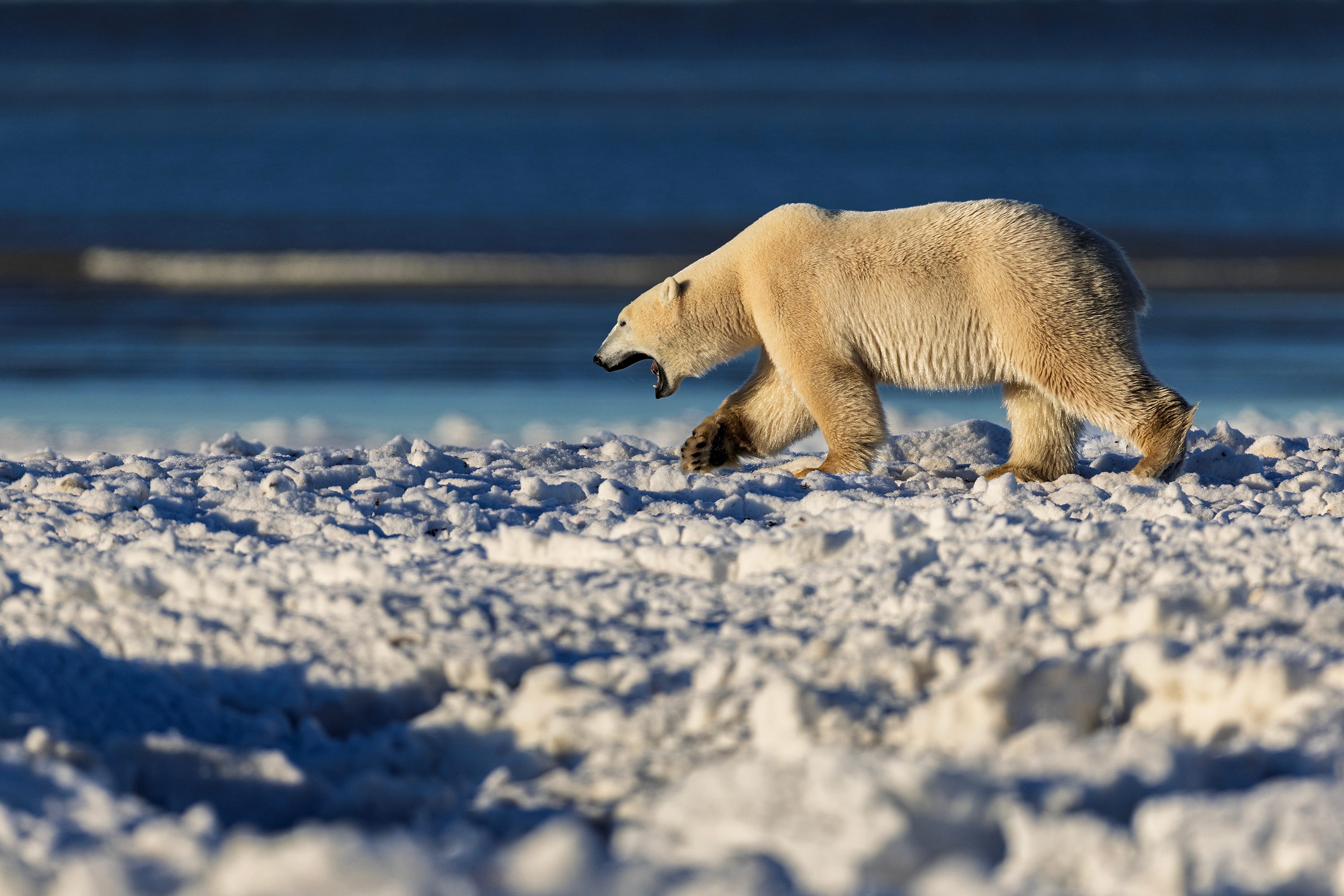
I’m writing this from Arviat, Nunavut, on the western shores of Hudson Bay, where I’ve come to spend time with polar bears.
I’ve been photographing polar bears in Churchill for the past seven years, but this is my first visit to Arviat. One of the reasons I wanted to come here was to experience a different part of the Arctic, somewhere quieter, with fewer visitors, and the opportunity to learn from Inuit guides who have spent their lives alongside these animals.
It’s an extraordinary place. The landscape is vast, the conditions can be unforgiving, and the wildlife has adapted to survive in an environment that most of us would struggle to endure for even a few days.
But as I spend time here, I’ve been reading about something that I find deeply troubling.
At the very moment the Arctic is undergoing some of the most dramatic environmental changes on Earth, we’re losing the research programs that help us understand what’s happening.
And I struggle to understand how that makes any sense.
We’re watching the Arctic change before our eyes
The scientific evidence of Arctic warming is overwhelming.
According to NOAA’s 2025 Arctic Report Card, the period from October 2024 to September 2025 was the warmest in the Arctic since records began in 1900. The last ten years have been the ten warmest on record.
In March 2025, Arctic sea ice reached its lowest annual winter maximum in the 47-year satellite record. And since the 1980s, more than 95% of the Arctic’s oldest, thickest sea ice has disappeared.
These are extraordinary changes within a remarkably short period of time.
For polar bears, sea ice is essential habitat. It’s where they hunt seals, their primary food source. Changes in when the ice forms, how long it lasts, and where it occurs can fundamentally alter their ability to survive.
But polar bears are only one part of a much larger ecosystem.
Changes in sea ice, snow cover, ocean temperatures, and vegetation are affecting everything from seabirds and marine mammals to fish, caribou, and the people who depend on these ecosystems.
We know the Arctic is changing. What we don’t fully understand is how all these changes will interact, how individual species will respond, and how quickly some of those consequences might unfold.
Which is precisely why long-term scientific monitoring is so important.
And yet we’re shutting down the research
On October 15, Yale Environment 360 published an investigation by Ed Struzik examining how Arctic wildlife research is suffering as geopolitical competition grows.
I found it so disturbing.
Andrew Derocher, a University of Alberta scientist who has spent four decades studying polar bears, told Yale Environment 360 that government support for polar bear research in Canada is at an all-time low.
Canada is home to 13 of the world’s 19 recognized polar bear subpopulations.
Yet Derocher described how little active research remains outside a handful of projects, including long-term monitoring in western Hudson Bay.
That’s a serious concern.
Polar bears are not one uniform population. Different groups experience different sea-ice conditions, hunting pressures, and ecological challenges.
Some subpopulations have been studied extensively. Others have significant gaps in their population estimates and demographic information.
Without regular monitoring, how do we know whether a population is increasing or declining? How do we identify changes in reproductive success or cub survival? How do we distinguish short-term fluctuations from long-term trends?
And how do we make responsible decisions about wildlife management when the evidence is incomplete or outdated?
We cannot manage what we don’t adequately understand.
And we certainly cannot assume that a population is doing well simply because we’ve stopped measuring it.
Apparently, we can afford to develop the Arctic, but not to understand it
This is the part I find particularly frustrating.
Governments are increasingly focused on the Arctic’s strategic and economic importance.
There’s growing interest in shipping routes, mineral resources, infrastructure, and national security. Canada alone has announced major investments in Arctic sovereignty and transportation infrastructure.
Some of those investments have legitimate purposes, including improving transportation and services for northern communities.
But scientific monitoring also serves the people who live in the Arctic. It helps communities understand changing wildlife distributions, sea-ice conditions, food security, and environmental risks.
I don’t see why these priorities should be treated as competing interests.
Surely, if we’re prepared to invest billions of dollars in developing and securing the Arctic, we should also be prepared to invest in understanding the ecosystems that make it such an extraordinary place.
The same problem is emerging in the United States.
In August 2026, the Trump administration ended NOAA’s direct support for the annual Arctic Report Card, a scientific assessment that had been published for twenty years.
The report brings together research from more than a hundred international contributors, documenting changes in Arctic temperatures, sea ice, wildlife, and ecosystems.
Fortunately, universities and scientific organizations have stepped in to help continue the report, although its editors have warned that support remains insufficient for a full release.
But why should something this important be left scrambling for funding?
We’re talking about one of the most rapidly changing regions on the planet.
Understanding what’s happening should be a basic responsibility of government, not something scientists have to fight to keep alive every year.
Science matters. So does Indigenous knowledge.
One of the things I’m particularly looking forward to during my time in Arviat is learning from the Inuit guides we’re working with.
There is an enormous amount of knowledge held by people who have lived alongside Arctic wildlife for generations.
They notice changes in animal movements, sea-ice conditions, seasonal patterns, and the availability of different species. Their observations can provide insights that short scientific field seasons might miss.
I think we sometimes make the mistake of treating scientific research and Indigenous knowledge as competing ways of understanding nature.
They shouldn’t be.
Both have enormous value, and they can be particularly powerful when used together.
Long-term scientific monitoring allows us to measure population trends, test hypotheses, and compare changes across large geographic areas.
Indigenous knowledge provides a depth of local understanding built through generations of observation and experience.
And I would argue that strengthening those partnerships should be a central part of Arctic conservation, not an afterthought.
But there’s another uncomfortable question
There’s something else worth considering.
Even when we have excellent science, are we actually willing to act on it?
We have decades of evidence documenting climate change, habitat loss, and declining biodiversity.
We’ve produced extraordinary research showing how human activities are affecting ecosystems across the planet.
And yet the political response has often fallen far short of what the science suggests is necessary.
One of the researchers interviewed by Yale Environment 360, ornithologist Mark Mallory, raised essentially this concern: how much more evidence do we need before governments take meaningful action?
I think it’s an important question.
We absolutely need to continue monitoring wildlife. Without good data, we risk making poor decisions and failing to recognize emerging threats.
But research cannot become an excuse for delaying action on problems we already understand.
We know greenhouse gas emissions are warming the planet. We know sea ice is declining. We know habitat destruction is placing enormous pressure on wildlife.
There is still much to learn about the details, but the broad direction of change is clear.
We need both: better scientific understanding and the willingness to act on the knowledge we already have.
What kind of future are we choosing?
As a wildlife photographer and guide, I’m incredibly fortunate to spend time in places like this.
I get to witness animals living in environments that most people will never experience firsthand. And I get to share those experiences through photography, storytelling, and the expeditions we run at The Wildlife Collective.
But I increasingly feel that simply showing people how beautiful these places are isn’t enough.
We also need to talk about what’s happening to them.
And we need to question the decisions being made about their future.
Because the loss of scientific monitoring might not attract the same attention as an oil spill, a disappearing glacier, or a dramatic decline in an animal population.
It’s quieter than that.
A research station closes. A field season is cancelled. A long-term dataset develops gaps. Scientists move on because funding disappears.
And gradually, our ability to understand the natural world becomes weaker.
The consequences may not become apparent for years.
By then, we may have missed important warning signs, lost opportunities to intervene, or made decisions based on information that was no longer reliable.
I don’t believe conservation can succeed without good science. But I also don’t believe science alone can save wildlife.
We need governments that recognize the value of long-term environmental research, communities that are meaningfully involved in decisions affecting their lands, and a public that understands why these investments matter.
Most importantly, we need to recognize that the natural world is not simply a collection of resources waiting to be developed.
It is an extraordinarily complex system of life, much of which we still barely understand.
And at a time when we’re changing that system faster than ever before, choosing to understand less about it seems an extraordinary decision.
I hope that years from now, my children will have the opportunity to visit places like Arviat and see polar bears living wild along the shores of Hudson Bay.
But hope alone won’t make that possible.
We need to understand what’s happening. We need to keep paying attention.
And we need to act on what we learn.
Quote of the Day
We are drowning in information, while starving for wisdom.
— E. O. Wilson
Thank you for being part of The Wildlife Collective. Together, we are helping build a deeper connection between people and the natural world while supporting the conservation of wildlife and wild places. Stay tuned for more stories from the field, conservation news, photography tips, and unforgettable wildlife encounters from around the globe.
Until next time, keep exploring, keep learning, and keep falling in love with the wild.
Zac Mills
The Wildlife Collective