
I’m currently at 35,000 feet, flying over the Arctic, on my way to India to see tigers, one of the most powerful wildlife experiences I’ve ever had. I love tigers in a way that’s hard to put into words, and even now, just thinking about those moments in the forest, I can feel my heart start to race.
But as much as I love this experience, there’s a reality that sits uncomfortably alongside it.
There are now more tigers in captivity than there are in the wild.
Let that sink in for a moment.
Today, there are roughly 5,000 to 5,500 wild tigers left across all of Asia. A century ago, that number was estimated to be over 100,000. They’ve lost more than 90 percent of their historic range, disappearing entirely from countries where they once roamed freely.
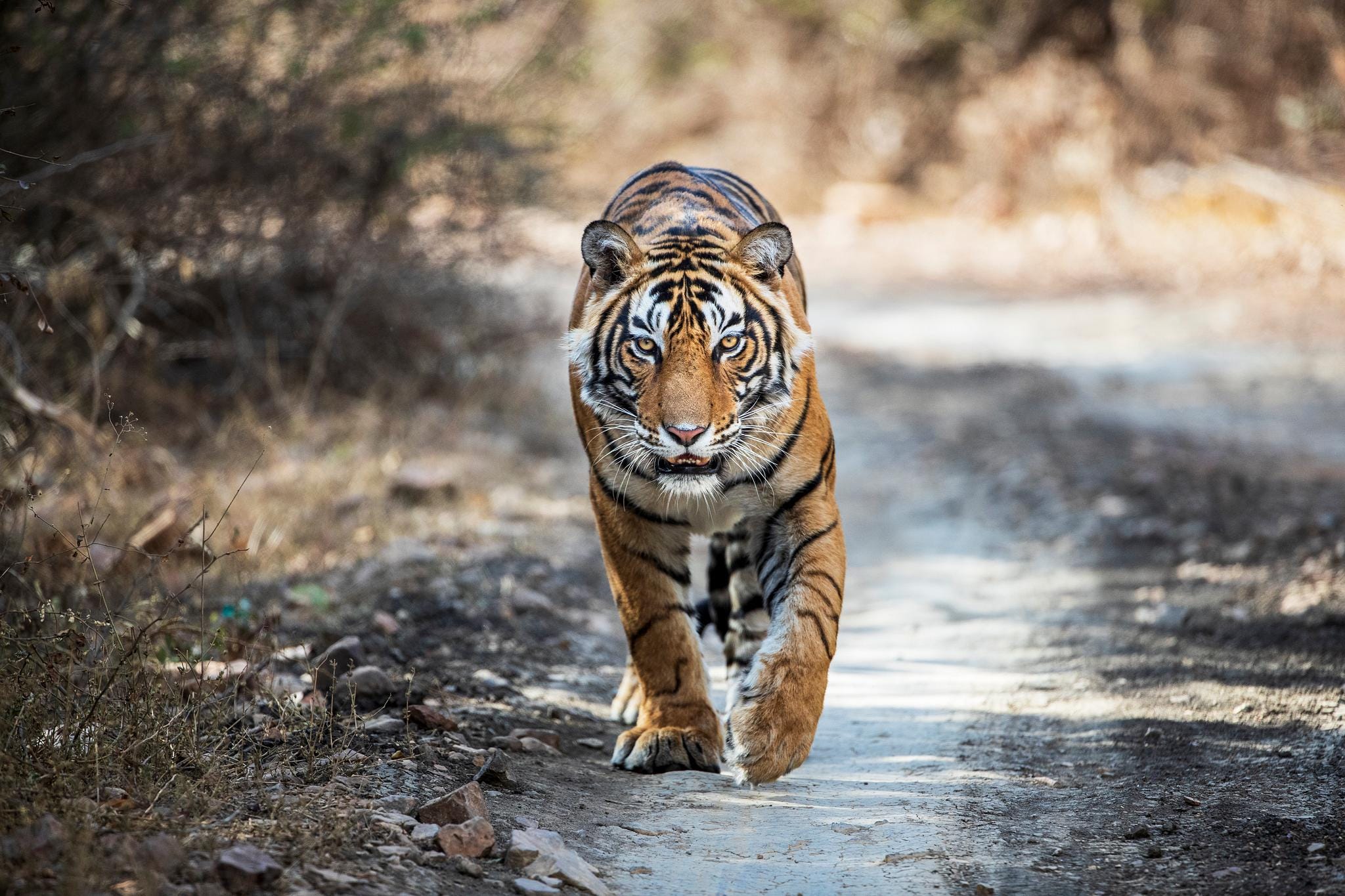
At the same time, there are believed to be well over 8,000 tigers in captivity globally, and that’s a conservative estimate. In the United States alone, there may be more captive tigers than exist in the wild worldwide. Many of these animals are held in private facilities, roadside zoos, or breeding operations with little to no conservation value.
India is now home to roughly 70 percent of the world’s remaining wild tigers, which, in many ways, is a remarkable conservation success story. Protected areas like Ranthambore and Bandhavgarh have become strongholds, where consistent protection, prey recovery, and community engagement have allowed populations to rebound.
But even there, the pressure never really disappears.
Because while we’ve been working to protect them in the wild, a parallel world has quietly expanded, one where tigers are bred, traded, and kept behind fences, often in numbers that far exceed those living freely. And in that world, their bodies are still treated as commodities.
Tiger bones, skins, teeth, claws. These aren’t just relics of the past. They are still part of an active black market. Tiger bone has historically been used in traditional medicine, particularly in parts of Asia, despite international bans. Skins are sold as luxury items. Teeth and claws are turned into jewelry and status symbols.
Poaching remains one of the greatest threats to wild tigers today. A single tiger can be worth tens of thousands of dollars on the illegal market when all its parts are sold. Organized crime networks are heavily involved, which makes it incredibly difficult to fully shut down the trade.
It’s a hard thing to reconcile.
On one hand, I’m heading into the forest, hoping to catch a glimpse of a wild tiger moving through its natural home, an encounter that feels deeply meaningful. On the other hand, there are thousands of tigers that will never know that life. Born into captivity, they exist not as apex predators shaping ecosystems, but as assets in a system that profits from their existence in entirely different ways.
And this is where the conversation becomes uncomfortable, but necessary.
Not all captivity is the same. There are legitimate sanctuaries doing important work, and there are conservation breeding programs with clear, science-based goals. But there are also facilities that blur the line, places where tigers are bred with no conservation value, where cubs are used for interactions, and where, at the end of their lives, their bodies may still enter illegal trade channels.
The problem is that these captive populations can actually undermine conservation in the wild. They normalize the idea that tigers are objects to be owned, displayed, or used. And perhaps most dangerously, they keep demand alive.
Because as long as there is demand, there will always be someone willing to supply it.
And then you find yourself back in the forest.
Sitting quietly on a tiger safari, the engine off, the air still, you begin to tune into everything around you. The alarm calls of deer. The sudden silence of birds. The faint imprint of tracks in the dust. You wait, sometimes for hours, knowing nothing is guaranteed, and that’s part of what makes it real.
And then, when a tiger finally steps into view, everything sharpens. Time slows. Your heart picks up.
In that moment, you feel it without question. This isn’t an animal that belongs behind bars. It isn’t something that can be reduced to parts, to value, or to a transaction.
This is an animal that shapes entire landscapes. A top predator whose presence tells you that an ecosystem is still functioning, still alive. A single tiger territory can span anywhere from 20 to over 400 square kilometers depending on prey availability, meaning their survival is directly tied to the protection of vast, intact ecosystems.
And when you see one, even briefly, you realize just how much we stand to lose.
We often talk about numbers when it comes to conservation. How many are left. How many have been saved. How many are at risk. But numbers don’t capture what it feels like to lock eyes with a wild tiger.
That’s the part that stays with you.
And it’s also the part that makes the rest of this so difficult to accept.
Because the real question isn’t just how many tigers are left in the wild.
It’s whether we’re willing to change the systems, the demand, and the mindset that still treat them as something to be owned, used, or consumed.
Because if we don’t, we may end up in a world where tigers still exist in large numbers.
Just not where they belong.
Quote of the Week
As long as there is demand, there will be supply.
— John Scanlon
Tour Updates
I’m really excited to launch our Colombia Andean Bears tour for January 17-22, 2027. This is a new offering for us as we continue to find the very best bear locations in the world. When I went on a scouting trip last year, I was completely blown away by the páramo in Chingaza National Natural Park. It’s a unique ecosystem, shaped by towering frailejones and a rich diversity of wildlife. It feels quite different from our Ecuador trip, which is more physically demanding. Colombia is a lot more relaxed, with more driving and less hiking, but equally as special. We’re keeping this one very small, just three guests, so it stays personal and flexible. If it resonates with you, just please let me know.
2026 Tours with Availability
June 16-24: Bolivia Jaguars on Foot (4 spots)
Sept 2-9: Kenya Big Cat Safari (2 spots)
Sept 13-21: Brazil Jaguars (2 spots)
*NEW Oct 19-26: Exclusive Polar Bears (waitlist) COMING SOON!
*NEW Nov 24-30: Mountain Gorillas (3 spots)
*NEW Nov 30 – Dec 5: Mountain Gorillas (3 spots)
Feel free to reply to this email with any questions, feedback, or just to share your latest wildlife photos. Feel free to share this message with fellow nature lovers, too—let’s grow this community together!
Thank you for being a part of The Wildlife Collective community. Stay tuned for more updates, conservation news, and incredible wildlife encounters!
Best regards,
Zac Mills
The Wildlife Collective