
For years, people have been asking me the same question.
“When are you going to make a photo book?”
My answer has always been some version of: “One day.”
Well, I think that day has finally arrived.
After thirteen years of traveling to Sumatra, I have decided that my first photo book will be about orangutans.
And if I’m being honest, I need some help.
I’ve never created a photo book before.
I’ve never designed one.
I’ve never worked with a printer.
I’ve never figured out how many copies to order, where to store them, how to ship them, or whether I should use a print-on-demand service.
But I do know one thing.
I have a story that I want to tell.
A story of one of the most remarkable animals on Earth, the incredible place they call home, the challenges they face, and the reasons I still believe there is hope for their future.
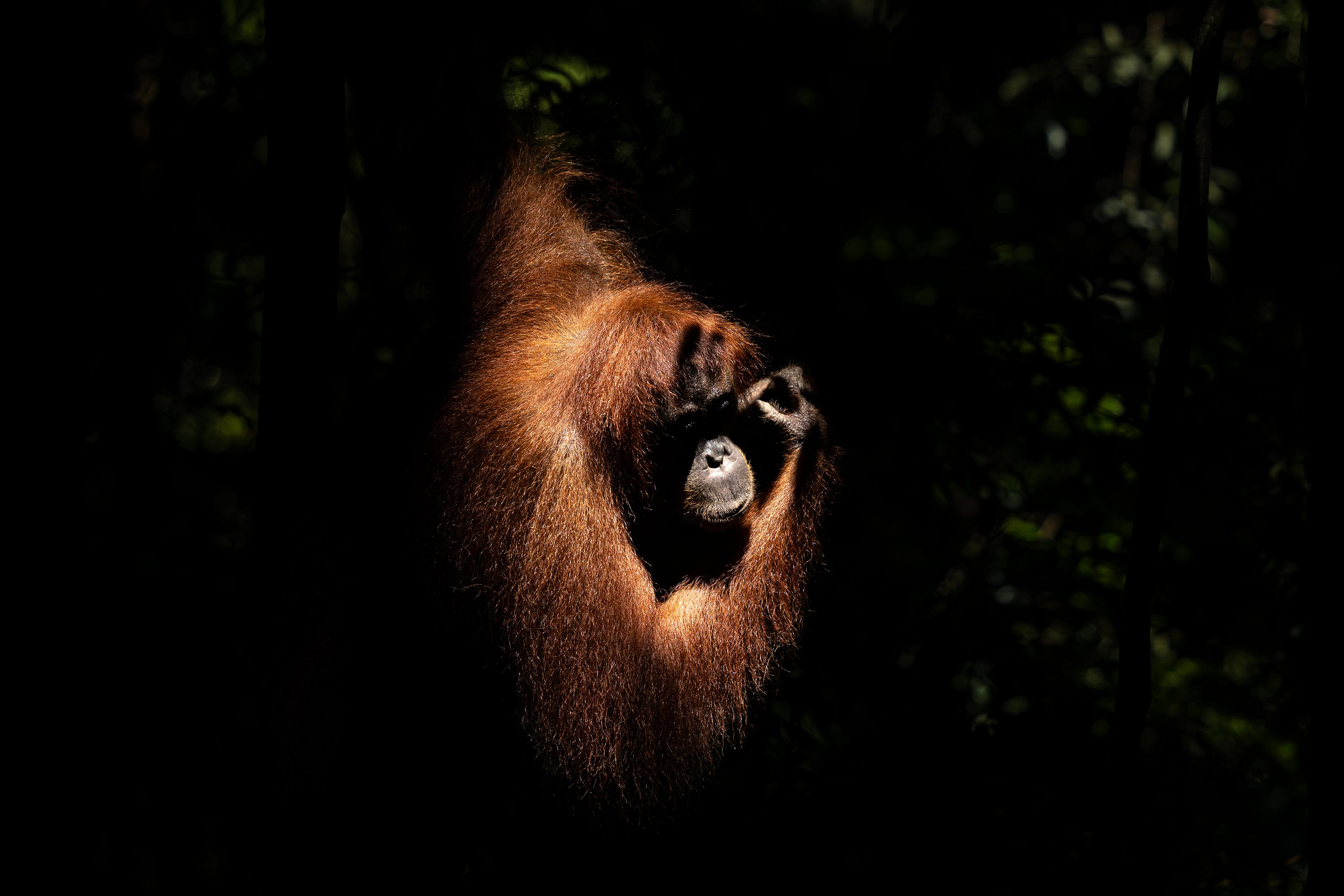
I’ve watched orangutan mothers guide their infants through the canopy.
I’ve seen massive flanged males emerge from the forest like prehistoric creatures.
I’ve listened to long calls echo through the jungle.
I’ve watched young orangutans play, learn, and grow.
And along the way, I’ve encountered countless other species that make Gunung Leuser one of the most extraordinary places on Earth. Thomas’s leaf monkeys, gibbons, hornbills, flying squirrels, pit vipers, elephants, and countless other creatures that most people will never have the opportunity to see. It is one of the last truly wild places left on our planet, and the only remaining ecosystem where orangutans, sun bears, elephants, rhinos, and tigers still share the same forest.
Yet despite the incredible diversity of life that surrounds me every time I visit, it is the orangutans that have always drawn me back.
There is something profoundly human about them. The way they care for their young. The way they think before acting. They are powerful and gentle at the same time.
They are familiar enough to remind us of ourselves, yet wild enough to remind us that there is still magic left in this world.
But over thirteen years, I’ve also watched the landscape around them change.
Each time I return, it seems there are more palm oil plantations pressing against the edges of the Gunung Leuser ecosystem. Vast stretches of rainforest that once connected wildlife habitat have been replaced by neat rows of oil palms. From the air, the contrast can be striking: one of the richest ecosystems on Earth bordered by an endless sea of monoculture.
It is a reminder that even places as extraordinary as Gunung Leuser are not immune to the pressures of a growing world.
And that is one of the reasons I want this book to be more than a collection of beautiful photographs.
I want it to tell the whole story.
I want this book to be truthful.
I want it to celebrate the wonder of orangutans while also acknowledging some of the uncomfortable realities of modern wildlife tourism, including the feeding and baiting of wild orangutans for tourist encounters.
Most importantly, I want it to be hopeful.
Because alongside the challenges, there are also extraordinary conservation stories.
Over the years, I’ve had the privilege of working with and supporting the Sumatran Orangutan Society and Nature for Change, and I’ve seen firsthand how conservation can succeed when local communities, conservationists, and supporters work together toward a common goal.
Too often, conservation stories focus only on what we’re losing.
I want this book to focus on what we’re saving.
I want people to fall in love with orangutans.
I want them to understand why these forests matter.
I want them to see the challenges.
But I also want them to leave inspired by the incredible people dedicating their lives to protecting one of the most remarkable species on Earth.
One thing I know for certain is that this book should give back.
A portion of every sale will support the important conservation work of the Sumatran Orangutan Society and their efforts to protect orangutans.
The problem is that I still have a lot to learn.
How should the book be designed?
Should it be a large coffee-table book filled primarily with photographs, or should it include longer essays and stories from the field?
What software should I use?
Should I self-publish or try to work with a traditional publisher?
Should I print a large number of copies and ship them myself, or use a print-on-demand service?
And what about Kickstarter?
Would you support a Kickstarter campaign to help bring this project to life? Would signed copies, limited editions, prints, or behind-the-scenes stories make it more interesting?
If you’ve created a photo book before, I would genuinely love your advice.
And if you’re simply someone who loves wildlife, photography, conservation, or orangutans, I’d love to hear what would make you excited to own a book like this.
Because the truth is, this project isn’t really about creating a book.
It’s about preserving a story.
A story that has been unfolding over thirteen years of muddy trails, early mornings, rain-soaked forests, unforgettable encounters, and countless hours spent watching one of our closest relatives in the wild.
One day, the photographs will outlive me.
My hope is that when someone opens this book years from now, they won’t just see images of orangutans.
They’ll feel something.
Wonder.
Connection.
Hope.
And perhaps they’ll come away believing what I’ve come to believe after thirteen years in Sumatra: that these forests are worth protecting, that orangutans are worth fighting for, and that a small group of dedicated people really can change the future.
If this book helps even a few more people fall in love with the wild, it will have been worth every step of the journey.
Quote of the Week
If a story is in you, it has to come out.
— William Faulkner
Conservation News
The Storm That May Have Changed the Fate of the Tapanuli Orangutan
When most people think about the threats facing orangutans, they think about chainsaws, palm oil plantations, logging roads, and deforestation. Those threats are real, and they remain some of the greatest challenges facing great ape conservation today. But a new study from Sumatra highlights another growing danger that receives far less attention. According to researchers, extreme rainfall and landslides linked to Cyclone Senyar in November 2025 may have killed an estimated 58 Tapanuli orangutans in just four days. For a species with fewer than 800 individuals remaining on Earth, that represents roughly 7% of the entire global population.
The Tapanuli orangutan is the rarest great ape on the planet. Found only in the Batang Toru ecosystem of North Sumatra, it was recognized as a distinct species as recently as 2017. Unlike Bornean and Sumatran orangutans, which occupy larger areas, the entire Tapanuli population survives within a relatively small and fragmented landscape. That means there is very little margin for error. A single catastrophic event can have consequences that echo through the population for decades. When you are talking about fewer than 800 animals, every individual matters.
The researchers used satellite imagery to map the impacts of the storm and identified more than 50,000 landslides across the region. Entire hillsides collapsed. Forests that had stood for generations were stripped away in a matter of hours. More than 8,000 hectares of orangutan habitat were affected, much of it within the most important stronghold for the species. Scientists believe many orangutans were likely killed directly by landslides, falling trees, and flooding. Others may have survived the storm only to face a very different challenge in the months and years ahead as food sources disappear and damaged forests struggle to recover.
What struck me most about this story is that it challenges the way many of us think about conservation. Traditionally, conservation has focused on protecting habitat, preventing poaching, reducing conflict with people, and limiting direct human impacts on wildlife. Those efforts remain essential, and they are the reason species like the Tapanuli orangutan still exist today. But climate change introduces a new layer of complexity. A forest can be protected from logging. It can be protected from mining. It can be protected from agricultural expansion. Yet it remains vulnerable to increasingly powerful storms, droughts, floods, wildfires, and other climate-driven events.
What makes the situation particularly concerning is how slowly orangutans reproduce. Female orangutans typically give birth only once every six to nine years, one of the slowest reproductive rates of any mammal on Earth. Conservation scientists have long warned that even small increases in mortality can push orangutan populations into decline. Losing an estimated 58 individuals in a single event is not something that can be quickly reversed. It represents decades of lost reproductive potential and a significant setback for a species already hanging on by a thread.
Conservation and climate change are often discussed as separate issues, but they are deeply connected. The future of orangutans will depend not only on protecting forests from destruction but also on addressing the broader environmental changes reshaping the planet around them. The forests of Sumatra can no longer be separated from the choices we make everywhere else.
Our 2026 Tours with Availability
Aug 16-20: Alaska Bear Camp (3 spots)
Sept 2-9: Kenya Big Cat Safari (2 spots)
Sept 13-21: Brazil Jaguars (2 spots)
Thank you for being part of The Wildlife Collective. Together, we are helping build a deeper connection between people and the natural world while supporting the conservation of wildlife and wild places. Stay tuned for more stories from the field, conservation news, photography tips, and unforgettable wildlife encounters from around the globe.
Until next time, keep exploring, keep learning, and keep falling in love with the wild.
Zac Mills
The Wildlife Collective